
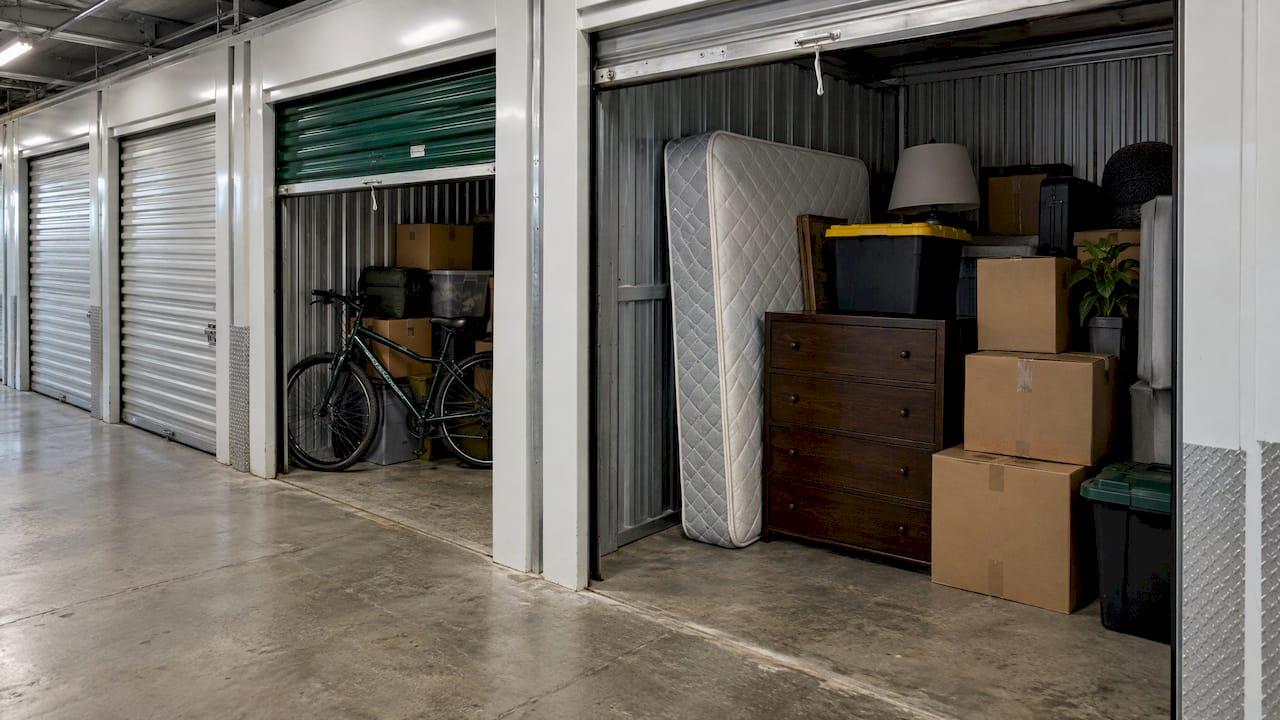
Storage unit sizes look simple until you’re standing in front of a chart that says “10x10” and you have no idea whether your couch, your bike and forty boxes will fit. Here’s the short version: the standard sizes run from 5x5 (25 square feet) to 10x30 (300 square feet), most of them with an 8-foot ceiling. Measure your biggest items, match your stuff to a room-sized comparison, and pick the size that leaves you a walkway. At Island Park Storage, our drive-up units run from a 2×3 at $29 per month up to an 8×40 at $399 per month, all month-to-month.
Below: the sizes, what each one holds, how to estimate your own, and how cars and bigger gear change the math.
TL;DR
- Standard US units run from 5x5 (25 sq ft) to 10x30 (300 sq ft), almost always with an 8-foot ceiling.
- Think in rooms: a 5x5 is a closet, a 10x10 is a bedroom, a 10x20 is a one-car garage.
- Advertised sizes are nominal, and the door opening is what decides whether a sofa gets in.
- Our drive-up units start at $29 per month (2×3) and go to $399 per month (8×40), with no deposit and no long-term contract.
- Storing a vehicle? Look at parking spaces, not boxes: 11×30 is $299 per month.
Table of Contents
- The standard storage unit sizes, in one chart
- Our sizes at Island Park Storage
- How to figure out what size you need
- Sizing for students and summer storage
- Sizing for small business inventory
- Storing a car, truck, RV or boat
- Does climate control change the size you need?
- Common sizing mistakes
- Our take on sizing
- Ready to pick a size?
- FAQ
- Sources
The standard storage unit sizes, in one chart
Most facilities in the US offer some mix of the same eight sizes. According to one size reference, those are 5x5, 5x10, 5x15, 10x10, 10x15, 10x20, 10x25 and 10x30. Some places also add small lockers under 5x5 and oversized units above 10x30, but those eight cover nearly everything.
Square footage is just width times depth. Multiply by the ceiling height and you get cubic feet, which is the real amount of space you’re renting.
| Size | Square feet | Think of it as | Roughly holds |
|---|---|---|---|
| 5x5 | 25 | Hall closet or dorm room | A few boxes, small furniture, seasonal gear |
| 5x10 | 50 | Walk-in closet | Studio or small one-bedroom contents |
| 5x15 | 75 | Large walk-in closet | A one-bedroom’s furniture plus boxes |
| 10x10 | 100 | Average bedroom | One- to two-bedroom apartment |
| 10x15 | 150 | Large bedroom | Two-bedroom apartment |
| 10x20 | 200 | One-car garage | Multi-room household, or a car |
| 10x25 | 250 | Extra-large garage | Large household or car plus extras |
| 10x30 | 300 | Two-car bay | Full house |
The comparisons to rooms, garages and moving trucks come from This Old House’s size guide. It matches a 10x10 to a 12-foot moving truck, a 10x15 to a 16-foot truck, and a 10x20 to a 22-foot truck. That truck trick is handy. If you already know it took a 16-foot truck to move you, a 10x15 is a good starting guess.
Which sizes do people actually rent?
The middle of the chart wins. Industry data says 10x10, 10x20 and 10x15 are the three most popular sizes, making up 60% of units, with the 10x10 alone near 23%. Trade reporting adds that the 5x10 remains the most popular size by rentals. Both can be true: facilities build lots of 10x10s, while many renters grab a 5x10 for a studio or a spare-room clear-out.

Our sizes at Island Park Storage
We don’t use the exact same sizes as the national chart, and that’s fine. Our units are drive-up container units with 24/7 gate access, and they come in a wide range. Here’s what’s on our units page, with square footage worked out so you can compare:
| Our unit | Square feet | Price per month |
|---|---|---|
| 2×3 | 6 | $29 |
| 3×4 | 12 | $55 |
| 5×5 | 25 | $79 |
| 5×8 | 40 | $115 |
| 8×10 | 80 | $179 |
| 8×20 | 160 | $279 |
| 8×40 | 320 | $399 |
How to read that:
- 2×3 and 3×4: locker territory. Think document boxes, a few totes, a bike wheel set, a small business’s paperwork.
- 5×5: the same footprint as the standard closet-sized unit. Our 5x5 guide goes deeper on what you can squeeze in.
- 5×8: a step above a 5x5, with 15 more square feet for a bit of furniture.
- 8×10: 80 square feet, so it lands between a 5x10 and a 10x10. Good for a studio or a one-bedroom if you pack smart.
- 8×20: 160 square feet, slightly more floor area than a 10x15. A solid pick for a two-bedroom move or a small business’s inventory.
- 8×40: 320 square feet, a little more floor than a 10x30. Big households, big inventory, or a project that’s taken over your garage.
Prices are the ones published on our site and can change, so check the units page when you’re ready to reserve.
How to figure out what size you need
The goal isn’t to guess. It’s to do ten minutes of measuring so you don’t pay for air or, worse, end up with a second unit. If you want another walkthrough on estimating how much space you need, that page covers the same idea from a moving angle.
Step 1: List the big stuff first
This Old House suggests starting with the items you need to store, measuring length, width and height, and starting with the largest. Do that. Mattress, sofa, dresser, table, bikes, and anything that’s an odd shape. Boxes fill in the gaps afterward.
Step 2: Match your home to a size
Use the room comparisons as a sanity check:
- Studio or one-bedroom: 5x10 territory (or our 8×10).
- One- to two-bedroom apartment: 10x10.
- Two-bedroom apartment: 10x15 (our 8×20 sits right around here).
- Multi-room house: 10x20.
- Full house: 10x30 (our 8×40).
Those pairings follow This Old House’s chart. They’re starting points, since a minimalist and a collector can live in the same apartment.
Step 3: Add a walkway
This is where people go wrong. Packed floor to ceiling with no path, you can’t reach the one box you need. A planning method from a storage calculator guide adds an access allowance and an allowance for odd-shaped items on top of the footprint of your stuff. In plain English: leave a lane, and don’t forget the bike.
If you’ll be in and out a lot (a small business pulling inventory, say), size up. If everything is going in for the summer and staying put, you can pack tighter.
Step 4: Check the door, not just the floor
Advertised dimensions are nominal. A 10x10 is frequently about 9 ft 6 in by 9 ft 8 in inside the walls, and the door opening is always narrower than the unit. That narrow door is what actually stops a sofa. Measure your largest piece, then measure the door.
Height matters too. The same 100 square feet holds 800 cubic feet at an 8-foot ceiling and 1,000 at 10 feet. Still, height matters less than floor space for most renters, because most things have to sit on the ground to be stored safely. Stack boxes smartly and you’ll gain room, but plan around floor area.
Sizing for students and summer storage
Students are the easiest case. A dorm room’s worth of stuff (a mini fridge, a desk chair, a bed frame, a few totes) usually fits a closet-sized space. The comparison charts put a 5x5 at about a dorm room or hall closet. Our 5×5 or 5×8 works for that, and with month-to-month terms and no deposit you pay for the summer and stop when you’re back. Sharing with a roommate? Split a 5×8 or an 8×10 and the monthly price gets friendlier.

And please, don’t pack the lamp last and the textbooks first. You’ll thank us in September.

Sizing for small business inventory
Inventory is a different game, because you keep going back for it. A few things to think through:
- Shelving. Shelves use height and keep boxes visible, but they eat floor space. Add that to your estimate.
- Access. Drive-up access means you can back a van up and load without hauling boxes through hallways. Our units have 24/7 gate access, so a 6 a.m. pickup works.
- Growth. Start with a size you can fill about two-thirds. Month-to-month means you can move up when the holiday rush hits.
For a small online seller, an 8×10 or 8×20 is a common landing spot. If you’re really just keeping paperwork and samples, a 3×4 may be all you need.
Storing a car, truck, RV or boat
This is where a storage unit chart stops helping and a parking space starts. Cars are long. Advice from a project-car sizing guide says to measure bumper to bumper, mirror to mirror and the tallest point, then add about 30 inches on the driver’s side so you can open the door, plus room at one end to walk around. It also notes a 10x20 matches a standard one-car garage, and a car plus parts really wants a 10x25 or 10x30.
Two more things from the same guide are worth knowing. Drive-up units usually have roll-up doors 8 to 10 feet wide and 7 to 8 feet tall, while interior units often have swing doors closer to 3 feet across, which rules out driving anything in. Get the door width, door height and clear interior height before you commit.
For vehicles, we skip the guesswork with dedicated parking on our vehicle storage page:
| Vehicle space | Price per month |
|---|---|
| 11×30 | $299 |
| 11×40 | $399 |
| 11×66 | $599 |
| Indoor motorcycle storage | $115 |
These suit cars, trucks, RVs, boats and commercial vehicles. Got more than one? We offer multi-vehicle discounts. Our 10x20 article covers the garage-sized question in more detail.
Does climate control change the size you need?
Not the size, but it can change what you rent if you’re storing for a while. Wood furniture, electronics, and paper are the usual worries on a long stay. If you’re planning three months or more, our guide on when climate controlled storage pays off walks through it.
Common sizing mistakes
- Sizing to the room, not the door. The floor can be huge and the doorway still too small for your sofa.
- No walkway. A packed unit you can’t walk into is a puzzle, not storage.
- Forgetting the vehicle’s real length. Car plus door swing plus a walk-around is longer than the car.
- Buying for the maybe. Month-to-month means you don’t need to rent for next year’s stuff today.
- Ignoring access. If you’ll visit often, drive-up beats a hallway of elevators. Our ground-level storage and accessible storage pages explain why.
Our take on sizing
We’ve watched the same thing happen over and over: people stress about picking the perfect size, and the answer is usually simpler than they think.
Start with your biggest item and the door. Think in rooms: closet, bedroom, garage. Then leave yourself a walkway. That’s it.
We built Island Park Storage around being easy. Drive-up units, a gate that’s open 24/7, and a manager on site who’ll talk through your stuff with you. Everything is month-to-month with no deposit, so if you pick a little big or a little small, you aren’t locked in. We’re seven minutes from downtown San Francisco with no city traffic to fight, which makes the loading part a lot less painful.
Not sure between two sizes? Come by, take a look, and we’ll help you figure it out. Nobody should lose their mind over a storage unit.
Mike
Ready to pick a size?
Whether you need a 2×3 for a few boxes, an 8×20 for a two-bedroom, or an 11×30 parking space for a truck, you’ll find them on our units page and vehicle storage page. Month-to-month, no deposit, gate access any time. Moving day? We also rent U-Haul trucks from $19 per day and sell boxes and moving supplies on site, so you can rent the truck and the space in one stop.
Reserve a unit on our site and you can be loaded up this week.
FAQ
What size storage unit do I need for a one-bedroom apartment?
A 10x10 is the common answer, and the size guides map it to a one- to two-bedroom home. If you’re packing tight and don’t need to walk in, a 5x10 can handle a studio or small one-bedroom. At Island Park, our 8×10 at $179 per month is a good fit for that range.
What is the most common storage unit size?
By rental popularity, the 5x10 is often named the top size, while the 10x10 is the most common size by the number of units built. Nationally, 10x10, 10x15 and 10x20 together are about 60% of units. Middle sizes win because they fit most households.
How tall are storage units?
Most have an 8-foot ceiling, though some run taller. Height is rarely advertised because floor area matters most for typical belongings. If you plan to store something tall, measure it against the door and interior height.
Will my car fit in a 10x20?
A 10x20 matches a standard one-car garage, so many cars and SUVs can fit, but you’ll need room to open a door. A car plus parts is more comfortable in a 10x25 or 10x30. For plenty of room, our 11×30 parking space is $299 per month.
Should I size up or down if I’m unsure?
Pick the size where you can leave a walkway. Because our rentals are month-to-month with no deposit, you can adjust later instead of guessing perfectly today.
Sources
- Storage unit sizes: dimensions, volume and size chart
- Guide to storage unit sizes, This Old House
- Guide to storage unit sizes and types, Innago
- Falling rents, shifting demand among self-storage trends
- Vehicle and parts storage: sizing a unit for a project car
- Storage unit size calculator guide
- Estimating how much storage space you need