
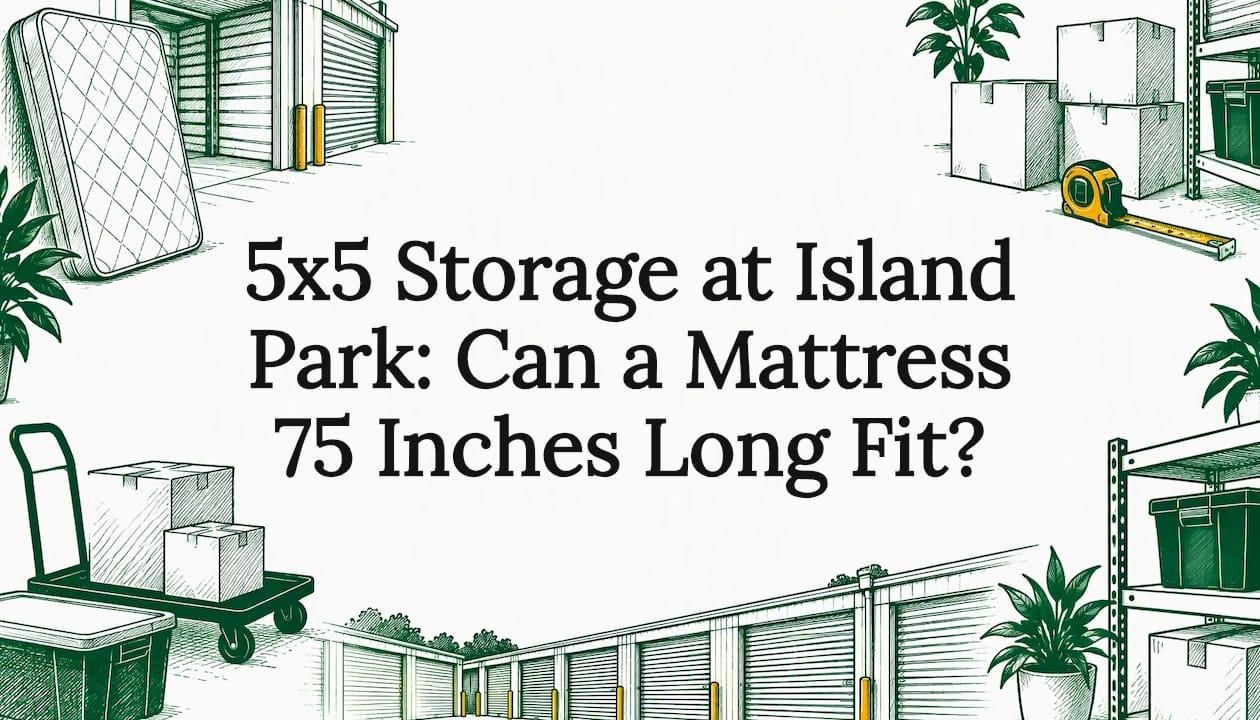
A 5x5 storage unit is 5 feet by 5 feet, or 25 square feet, and holds roughly 200 cubic feet with an 8-foot ceiling. Think of a small closet. It suits boxes, seasonal items, and a chair or nightstand. If you’re storing a mattress set or several furniture pieces, go with a 5x10 or larger.
TL;DR:
- A typical 5x5 offers 25 square feet and about 200 cubic feet, but measure the ceiling, door, and largest item because dimensions vary by facility.
- Expect about 8–15 medium boxes; reserve less if you need an aisle, while uniform boxes, shelving, and vertical stacking can improve access.
- A twin mattress usually fits, but a full mattress only fits upright and consumes most of the unit; queen and king mattresses need larger space.
- A 5x10 unit doubles floor area to 50 square feet; choose it for more than 15 boxes, a mattress set, or several furniture pieces.
- Island Park Storage lists a 5x5 at $79 per month, with flexible contracts and no deposit; confirm fees and access needs before booking.
Table of Contents
- How big is a 5x5 storage unit, really?
- What fits in a 5x5 storage unit?
- How do you pack and stack a 5x5 without wasting space?
- 5x5 vs 5x10: when should you upgrade?
- What should you check before renting a 5x5?
- How much does a 5x5 storage unit cost?
- What security features matter for a 5x5 unit?
- How easy is it to get to your 5x5 at Island Park Storage?
- Who is a 5x5 storage unit best for?
- When do we recommend a 5x5?
- Ready to check availability for a 5x5?
- FAQ
- Sources
How big is a 5x5 storage unit, really?
The nominal footprint is simple: 5 feet wide by 5 feet deep, which gives you 25 square feet of floor. Most facilities run an 8-foot ceiling, so the math is 25 square feet times 8 feet, or about 200 cubic feet. A comparison of 5x5 and 5x10 units puts the 8-foot ceiling volume at roughly 190–200 cubic feet, which matches.
Here’s what that number means in practice:
- Floor space: 25 square feet, about the size of a walk-in closet.
- Ceiling height: most units sit near 8 feet, though a few facilities build taller. Always confirm the height of the exact unit you’re renting.
- Usable volume: about 200 cubic feet if you stack all the way up, which you’ll only manage with sturdy boxes and a little planning.
- Shelving multiplier: a freestanding shelf turns dead vertical space into real capacity, so a taller ceiling plus shelving can stretch a 5x5 further than the raw numbers suggest.
Dimensions vary a little from one facility to the next, so treat 5x5 as a label, not a guarantee. Measure your biggest item first, then check it against the unit.
What fits in a 5x5 storage unit?

Boxes are where a 5x5 shines. One storage guide lists a capacity of up to about 8–15 medium boxes depending on stacking and ceiling height. Plan on the lower end if you also want a walkway, and the higher end if you’re willing to stack to the ceiling.
Here’s a realistic load:
- A dozen or so medium boxes, or a similar count of plastic bins
- A chair, end table, or nightstand
- A small dresser or narrow bookshelf (one or two pieces, not a whole room)
- Seasonal décor, camping gear, or holiday bins
- A bike, if you stand it upright
Mattresses are the big question. A twin mattress (38 by 75 inches) usually fits. A full is another story: a full-size mattress measures 54 by 75 inches, and that 75-inch length (6.25 feet) is longer than the 5-foot footprint. It can’t lie flat. Some facilities say a full fits only if you disassemble the frame and stand the mattress on its edge, and even then it eats most of your space. Queen (60 by 80 inches) and king (76 by 80 inches) mattresses exceed 5 feet in at least one direction, so skip the 5x5 for those.
Full-size mattress: 54 × 75 inches. At 6.25 feet long, it’s taller than the unit is wide, so it only fits standing up. Sleep Foundation lists these standard dimensions.
Three quick scenarios:
- Student storage: a twin mattress, a mini fridge, six or seven boxes of books and clothes, and a desk lamp.
- Seasonal decor: holiday bins, a fake tree in its box, wreaths, and patio cushions.
- Small office archive: file boxes stacked on a shelf, with a chair and a small filing cabinet at the front.
Mixing many furniture pieces is where people get burned. Two small items plus boxes works. Four furniture pieces plus boxes does not.
How do you pack and stack a 5x5 without wasting space?
A few habits turn a tight unit into a usable one:
- Pick uniform boxes. Same-size medium boxes stack like bricks. Odd sizes leave gaps.
- Label every side. You’ll thank yourself later when you’re digging for the one box you need.
- Heavy goes low. Books and tools on the bottom, lighter stuff on top.
- Go vertical. Stack to just below the ceiling, and use plastic bins for stacks that won’t crush.
- Add a shelf. A freestanding shelving unit keeps things off the floor and makes boxes reachable.
- Leave a narrow aisle. Leaving a narrow aisle down one side saves you from unloading everything for one item.
- Front-load what you’ll grab. Seasonal items you’ll swap twice a year go near the door.
Pro Tip: Vacuum bags shrink bedding and cushions a lot. If you must store a mattress, stand it on its long edge, but check the door width and the facility’s rules first.
5x5 vs 5x10: when should you upgrade?
A 5x10 doubles your floor area to 50 square feet and roughly doubles the volume and box count. That extra room is what lets a mattress lie flat or a couch fit.
Upgrade if any of these describe you:
- You’re storing a mattress set (full or larger).
- You have a couch, a dining table, or several big furniture pieces.
- You’re packing more than about 15 boxes.
- You’re unsure and your estimate keeps creeping up.
Another size guide frames a 5x5 as a light-overflow unit and a 5x10 as the fit for a studio or single-room move. The price gap between them varies by market, but when you’re on the fence, the bigger unit usually costs less than a second trip and a second rental. Moving everything twice is the expensive option.
What should you check before renting a 5x5?
Run this list on the phone or in person:
- Interior dimensions and ceiling height. Get them in writing or measure yourself.
- Door width and type. Roll-up and swing doors behave differently, and your largest item has to clear the opening.
- Drive-up access. Can you park at the door, or will you haul items down a hallway?
- Climate control and unit location. Ground floor or interior? This matters for wood, electronics, and papers.
- Access hours, security, and insurance rules. Know when you can get in and what’s required.
- Your own measurements. Bring the sizes of your biggest items and ask whether staff can let you do a quick check in person.
If a facility won’t let you look at the space before you rent it, that tells you something.
How much does a 5x5 storage unit cost?
Prices for small units swing a lot by city, so treat any bracket as directional. The biggest price movers are features:
- Climate control adds cost, and so does an indoor location.
- Drive-up access and 24/7 gate access are convenient, and convenience is often priced in.
- Move-in fees and deposits can add up quickly, so ask what’s due on day one.
- Contract style matters: month-to-month keeps you flexible, while long commitments can lock you in.
At our facility, a 5×5 self-storage unit is $79 per month, on a month-to-month contract with no deposit required.
To keep costs down, compare amenities line by line, skip features you won’t use, and rent only the space you need.
What security features matter for a 5x5 unit?
For a small unit, the basics do most of the work. Start with the lock: you supply your own, so choose a solid disc lock or a hardened padlock rather than a thin hardware-store one. A cheap lock on a good door is still a weak link.
Then look at what surrounds the unit:
- Gated entry: a controlled gate keeps random traffic off the property.
- Cameras: ask whether they cover the gate and the lanes where units sit, and whether footage is kept.
- Lighting: a well-lit property discourages after-hours trouble.
- On-site management: a person who knows the property and its regulars notices when something looks off.
- Insurance: your belongings may not be covered by the facility, so ask what’s required and check your renter’s or homeowner’s policy.
At our place, we run 24/7 gate access, which means you can reach your things at any hour, and we have a manager on site who knows the facility. The practical side of security is also about how you pack. Keep valuables toward the back, keep your unit tidy so you can see at a glance if something shifted, and photograph your contents when you move in. A quick photo set can help with any future claim.
If security is your top worry, ask any facility to walk you through exactly what happens at the gate and what’s recorded. A clear, confident answer is a good sign. A vague one is your cue to keep shopping.
How easy is it to get to your 5x5 at Island Park Storage?
Access is the thing small-unit renters complain about most, so we built around it. We’re a drive-up facility, with container units you can pull right up to, which beats carrying boxes down a long hallway or waiting on an elevator. Our gate is open 24/7, so a late-night grab of a winter coat or an early-morning pickup before work is no problem.
We’re near downtown San Francisco, with no city traffic to fight on the way. That makes a quick stop on your lunch break or a Saturday swap of seasonal bins realistic instead of a half-day project.
Here’s what that means for you in day-to-day terms:
- Drive-up convenience: back your car up to the door and load straight in.
- No elevator waits: these are container units, not an indoor stack of floors.
- Anytime entry: the gate doesn’t keep office hours.
- Real people: our manager is on site, so you can ask about unit placement, measurements, or what fits.
If you have mobility concerns or a specific access need, tell us before you reserve. We’d rather talk it through and match you to the right unit than have you find out on move-in day. A quick call or visit lets you see the layout, check the door opening against your largest item, and decide whether it works for how you move.
Who is a 5x5 storage unit best for?
A 5x5 earns its keep for people with a defined, modest pile of stuff. A size guide describes it as the size of a small closet and recommends it for light overflow loads such as college summer storage, seasonal items, or small-office archives.
Common fits:
- Students: summer break is the classic case. A twin mattress, a mini fridge, and a few boxes of books, and you’re done.
- City dwellers short on closets: holiday decorations, ski gear, camping equipment, and luggage that you only need a few times a year.
- Small business owners: archived files, spare inventory, trade-show supplies, or a few cartons of product that don’t fit the back office.
- Downsizers and movers in between homes: a handful of sentimental boxes and one or two small furniture pieces while you sort out the next place.
- Hobbyists: craft supplies, sports equipment, or tools that crowd the apartment.
The pattern is the same everywhere: boxes and bins with a couple of small items. If your list is mostly furniture, you’re likely a 5x10 customer. Write your inventory down before you call. If it fits on half a page and has no large furniture, a 5x5 is probably right.
When do we recommend a 5x5?
We tell people to pick a 5x5 when the load is seasonal overflow, a student’s belongings, or archived boxes. That’s the sweet spot, and we’d rather you pay for exactly the space you need.
A few things about our facility make small units easy to live with: drive-up container options, 24/7 gate access, month-to-month contracts with no deposit required, and a manager on site. You can start small, and if you outgrow the unit, you can move up.
Our honest advice is to stop by or call and measure before you commit. Bring your largest items, look at the door, and check the fit with your own eyes. Measuring beats guessing.
— Mike
Ready to check availability for a 5x5?
Here’s the quick route to reserving your unit:
- Browse sizes and current availability on our units page, or call us.
- Measure your biggest items first, so we can confirm they’ll fit before you book.
- Ask our on-site staff to double-check dimensions if you’re on the line between a 5x5 and a 5x8.
- Pick month-to-month, with no deposit required, and use 24/7 drive-up access whenever you need it.
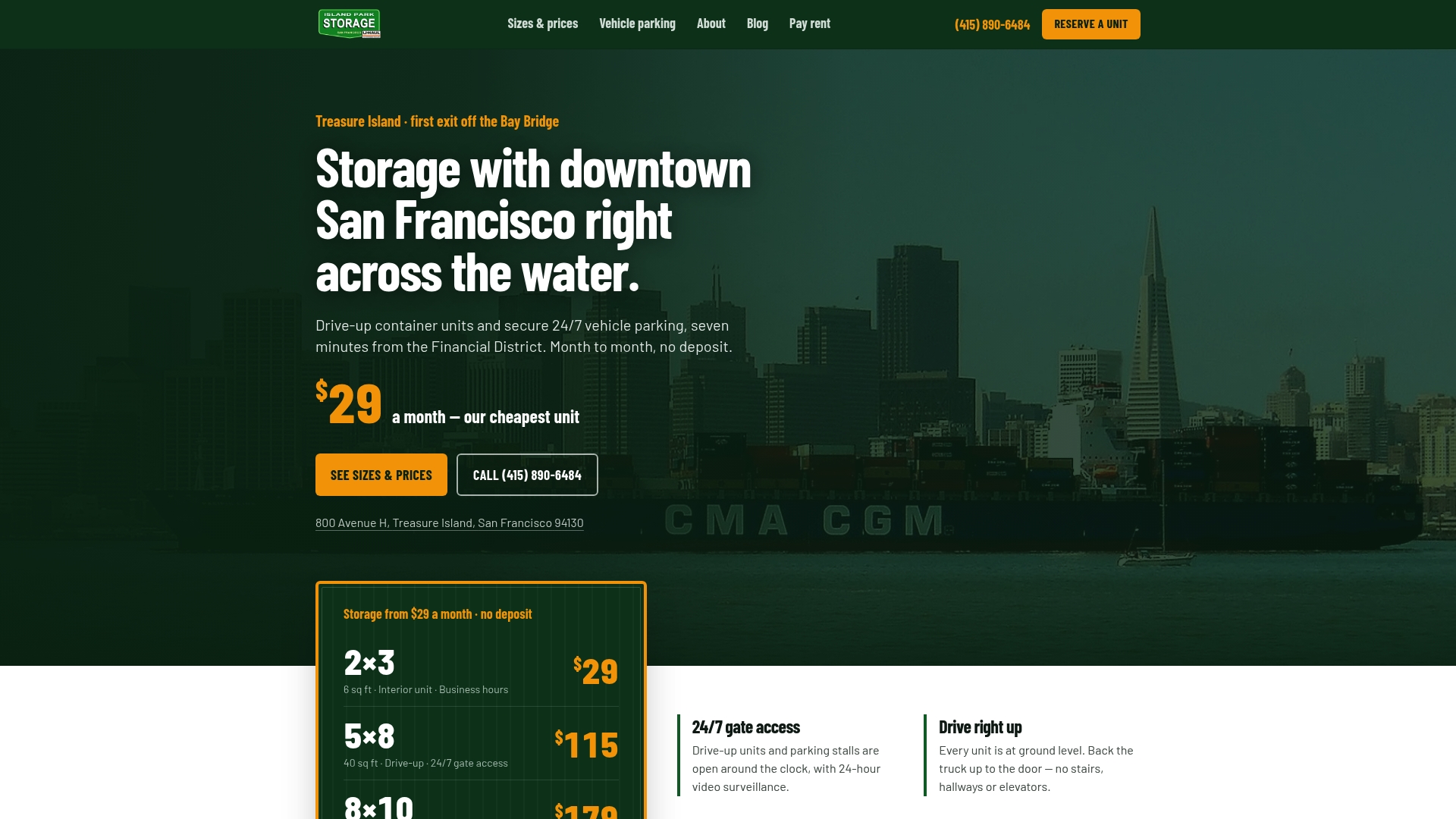
Reserve your 5x5 with Island Park Storage, and you can arrange your move-in.
FAQ
What is the actual size of a 5x5 storage unit?
A 5x5 unit is 5 feet by 5 feet, or 25 square feet of floor space. With a typical 8-foot ceiling, that comes to about 200 cubic feet. Exact dimensions can vary slightly by facility.
What can I fit in a 5x5 storage unit?
Plan on boxes, seasonal items, and small furniture such as a chair, end table, or nightstand. One guide lists up to about 8–15 medium boxes depending on stacking and ceiling height. A twin mattress usually fits too.
What does a 5 by 5 storage unit look like?
Picture a small closet, about the size of a walk-in with the door open. Storage guides commonly use that comparison. It’s tall enough to stack boxes toward the ceiling but too tight for a large furniture set.
Can a full-size bed fit in a 5x5 storage unit?
Not lying flat. A full mattress is 54 by 75 inches, so its length is greater than 5 feet. It may fit standing on edge after disassembly, but that uses most of the unit, so a 5x10 is the safer pick.