
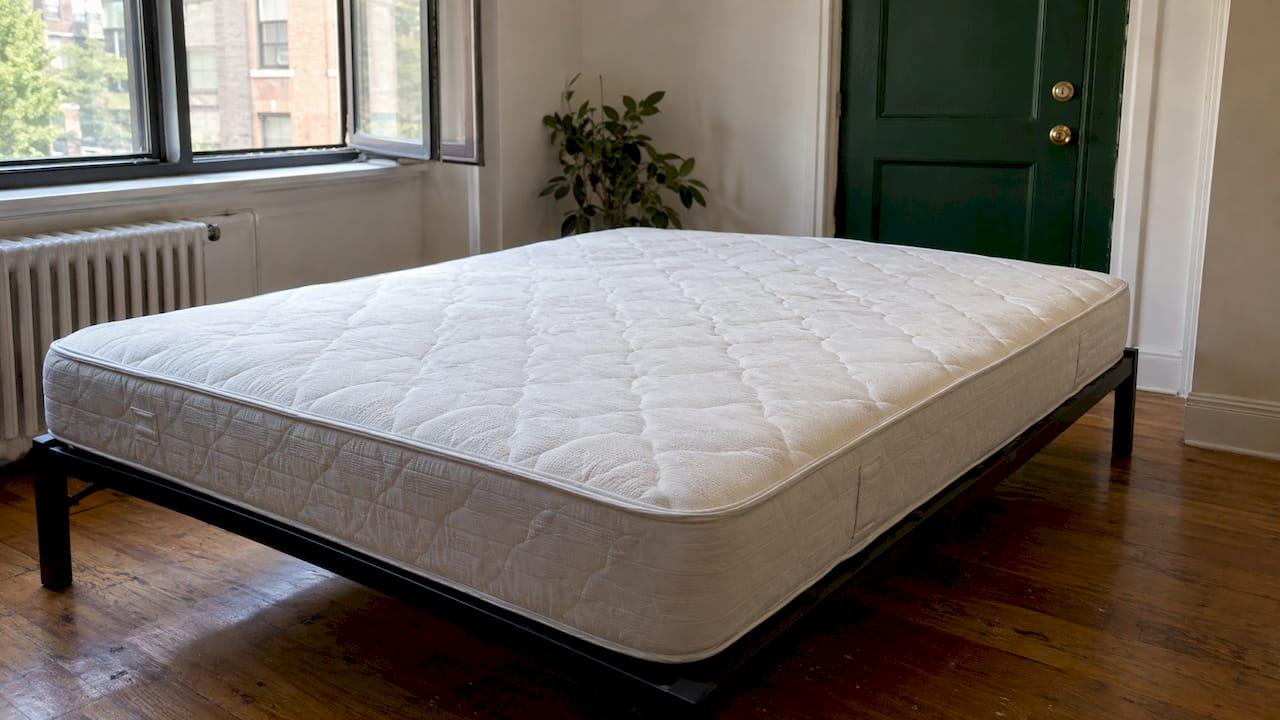
To store a mattress, clean it, let it dry all the way, slip it into a thick mattress bag, and lay it flat in a dry spot with nothing heavy on top. That’s the whole recipe. The details (bag thickness, how long is too long, flat versus upright) are what separate a mattress that comes out fresh from one that smells like a basement. We’ll walk through all of it, without losing your mind.
TL;DR
- Clean the mattress, then let it dry completely. Trapped moisture is what causes mold and odors.
- Use a sturdy mattress bag (thicker is better) and seal the seams with duct tape. Skip airtight vacuum sealing for long stays.
- Lay it flat if you can. Upright works for shorter stays, but only with full-side support.
- Plan on roughly six months to a year. Longer stays call for a dry, steady-temperature space.
- Raise it off the floor on a pallet or similar, and never stack heavy stuff on it.
Table of Contents
- Before anything else: clean and dry it
- Picking the right mattress bag
- Flat or upright?
- How long can a mattress stay in storage?
- Where you store it matters
- No spare room? Small-space ideas
- Storing a mattress in a self-storage unit
- Need a spot for your mattress? We’ve got you
- A quick word on car covers
- FAQ
- Sources
Before anything else: clean and dry it
A dirty mattress in a closed bag is a science experiment. Start with a good cleaning.
The Sleep Foundation’s step-by-step goes like this: dab stains with a washcloth dampened with water and mild soap, sprinkle baking soda over the top for an hour, vacuum it up, then repeat on the other side. After that, cover it in a mattress bag or plastic sheeting secured with duct tape.
Want to go a little deeper? A cleaning pro quoted by Yahoo Health suggests vacuuming every side with the upholstery tool and letting baking soda sit for at least eight hours. For stubborn spots, he uses a mix of hydrogen peroxide, dish soap and water. HGTV adds that an enzyme-based odor remover helps with organic stains.
The step people skip is drying. Let the mattress air dry completely before it goes anywhere near a bag. HGTV points out that this matters most in spaces without climate control, where leftover dampness can turn into mold.
How fast can that happen? According to the same Yahoo Health piece, in a dark, moist environment mold can start growing within 24 hours. Within one to two weeks you may see spots and smell it. Foam also breaks down faster when wet, and springs can corrode. So give it a sunny afternoon or a day by an open window. It’s worth the wait.

Picking the right mattress bag
A bag keeps out dust, pests and spills. It also keeps the mattress clean on the ride over, which matters if it’s going through a stairwell or the back of a truck.
Thickness and style
Thicker plastic survives a lot more abuse. Vaya Sleep recommends bags at least 4 mil thick for durability, and notes that a sealed bag keeps bed bugs and other pests from hitching a ride.
If you’d rather not wrap a mattress in plastic, American Mattress recommends a protective cover made from breathable material to keep moisture from building up. If you do use thin plastic wrap, they say to seal every opening and seam with duct tape to keep out dust, pests and moisture.
Breathable versus sealed is a real trade-off for longer stays. Sealy says plastic wrapping is fine, but it doesn’t recommend airtight packaging or vacuum sealing. For a stay of many months, a heavy-duty bag with a few small gaps taped closed beats a vacuum-sealed brick.
Queen and king bags, and sizes
Mattress bags are sold by mattress size, from twin up to California king. Buy the one that matches your mattress, and if it’s a pillow top or extra thick, look for a bag labeled for thicker mattresses. A bag that’s too snug splits at the corners. A bag that’s way too big flaps around and tears.
Here’s a quick checklist for shopping:
- Size: match the bag to your mattress size (twin, full, queen, king, California king).
- Thickness: aim for 4 mil or more if you can.
- Seal: zip, adhesive strip or tape. Plan on duct tape for backup either way.
- Handles: a nice bonus if you’re hauling it yourself.
Heavy-duty bags are cheap compared to the mattress inside. Replacing a moldy queen costs a lot more than a bag.
Vacuum bags: short stays only
Vacuum-sealed compression bags are tempting because they shrink everything down. But The Spruce says a mattress can stay in a vacuum bag for up to three months, and that longer than that can permanently damage its shape, alignment and structure. Fine for a quick summer gap. Not great for a year abroad.
Flat or upright?
Short answer: flat wins.
Sealy recommends storing a mattress as flat as possible with little to nothing stacked on top, and warns that turning it on its side can seriously compromise its structure. HGTV quotes a mattress maker’s executive who says flat keeps wool and latex layers from migrating away from the coils. Once layers separate, you can end up with lumps and uneven support.
Foam, latex and hybrid mattresses are the pickiest. A sleep expert quoted by Yahoo Health says these tend to be less forgiving than innerspring mattresses, because they’re sensitive to moisture, heat and prolonged pressure. Long-term vertical storage can cause sagging, shifting layers or misshaping, especially in foam.
If you have to go upright (it happens, space is space):
- Keep it to a shorter stay.
- Support the full side of the mattress, so it isn’t bowing against a wall or leaning at an angle.
- Don’t let it slump. A mattress leaning on one corner is a mattress with a new personality.
And skip the temptation to use it as a shelf. Don’t stack boxes or furniture on top. Pressure is the enemy.
How long can a mattress stay in storage?
There’s no single magic number. Here’s what the experts say:
| Source | Guidance |
|---|---|
| Yahoo Health | Experts generally suggest about six months. Under ideal conditions, a high-quality mattress may last up to a year without major issues. |
| The Spruce | Up to three months in a vacuum bag. Longer risks permanent damage. |
Our takeaway: for a few weeks to six months, you’re in great shape if you prep well. Toward a year, the conditions matter more (dry, steady temperature, flat, nothing on top). If you’re planning to be away longer than that, check the mattress partway through and give it a little air.

Where you store it matters
A garage, attic or basement can work. They can also be heat and humidity traps.
- Humidity: Yahoo Health cites the EPA’s guidance to keep indoor humidity below 60%, ideally between 30 and 50%, to cut down on mold and mildew.
- Heat: attics can hit well above 100°F in summer, according to Coastal Moving Services. At those temperatures foam can soften and deform, and the glue between foam layers can break down.
- Temperature: Sealy recommends a dry space at a moderate temperature, typically 68 to 72°F.
- Off the floor: Better Homes & Gardens suggests setting the mattress on a wooden pallet so it can breathe, and adding a dehumidifier if you’re in a garage, attic or basement that isn’t climate-controlled.
If you’re storing for three months or more and your mattress is a pricey one, it’s worth reading up on when climate-controlled storage pays off. It helps you decide what level of protection fits your stuff and your timeline.
No spare room? Small-space ideas
Not everyone has a garage. If you live in a San Francisco apartment, you know the feeling. A few ways to buy back space at home:
- Slide it under another bed. Mattress Firm lists this as a creative temporary idea when space or budget rules out a storage unit, and recommends covering the mattress with a cover or plastic to keep out pests, moisture and debris.
- Use a lift-up storage bed. One Domino writer turned a tiny studio around with a lift-up bed that created a hidden closet under the mattress for towels, bedding and coats.
- Go vertical with a Murphy bed. Lori Beds explains that a vertical Murphy bed stores the mattress upright inside a cabinet, which frees up floor space during the day.
Those are great if you’re also sleeping on the bed. But if you’ve got a spare mattress, a guest bed, or a mattress you’re parking while you travel, moving it out of the apartment altogether is often the cleanest answer.
Storing a mattress in a self-storage unit

A unit gives you a dedicated, out-of-the-way spot where your mattress isn’t competing with the bikes, the holiday boxes and the Roomba.
Here’s how to set it up:
- Prep it. Clean, dry, bagged and taped, as above.
- Lay it flat on a pallet or a few clean boards. Raise it off the floor.
- Put the mattress down last, or on top of a sturdy platform. Think “mattress bed” rather than “mattress shelf.” Nothing heavy on it.
- Leave a little breathing room around the edges instead of cramming it against walls and boxes.
- Peek in now and then. A quick check every month or two catches problems early.
Which size do you need?
Measure your mattress first, then measure the unit’s door too. A few of our unit sizes and monthly prices (as published on our units page):
| Unit | Monthly price |
|---|---|
| 5×5 | $79 |
| 5×8 | $115 |
| 8×10 | $179 |
| 8×20 | $279 |
A 5×8 is 60 inches by 96 inches, so there’s room to lay a mattress flat if it’s narrower than that. If your mattress is on the longer side, we’ve written a guide on whether a mattress about 75 inches long fits in a 5×5. If you’re also moving a one-bedroom’s worth of furniture, our 10×10 guide shows what fits. And if you’re torn between sizes, the 5×10 guide starts with measuring the door.
Sharing a unit
Splitting a unit with a roommate or partner? You’ll want to settle who gets what space, where the mattress goes, and who pays what. This guide on sharing a storage space with roommates is a handy way to sort it out before move-out day gets messy.
Protect your stuff
A mattress is a decent-sized investment. Our guide on what self-storage insurance covers and what you can skip helps you decide how to protect it. And if the mattress is just one thing among many, our long-term clothing storage tips are a good companion for the bedding and linens you’re stashing alongside it.
What we’d tell a friend
We see a lot of mattresses roll through the gate. The ones that come out happy have three things in common: they were clean and dry going in, they were bagged in something sturdy, and they were laid flat instead of propped up like a surfboard.
That’s also why we like drive-up units. You pull up to your door, slide the mattress in flat, and you’re not hauling it down a hallway or into an elevator. Our rentals are month-to-month with no deposit, so you aren’t signing up for a year to store one bed. And since the manager is on site, you can ask which size makes sense before you commit.
Need to come back in March to grab it for a guest? The gate is open 24/7. You can stop by when it suits you.
Mike
Need a spot for your mattress? We’ve got you
Island Park Storage is about seven minutes from downtown San Francisco, with drive-up units, 24/7 gate access, and month-to-month rentals with no deposit. Sizes start at 2×3 for $29 per month, and run up through 5×5 at $79 and 5×8 at $115. You can also pick up boxes and moving supplies, and rent a U-Haul truck from $19 per day, if you’re moving the mattress yourself.

See all sizes and reserve a unit, or stop by the Island Park Storage homepage to see what else we offer.
A quick word on car covers
Some folks storing a mattress are also parking a car, and they ask about covers. If your vehicle is going to sit outdoors, Car and Driver says an outdoor cover should resist rain and UV, and fit securely in wind. It should be snug enough not to billow or drag on the ground, but not so tight that it strains the seams. They also note moisture can still collect under a breathable cover, especially if the car was wet when covered, so check it periodically, particularly after a storm.
We offer vehicle parking in 11×30 ($299 per month), 11×40 ($399) and 11×66 ($599) sizes, plus indoor motorcycle storage at $115 per month. Details are on our vehicle storage page, and our classic car storage tips cover prep and wake-up. For a few more storage reads, the Island Park blog is a good place to browse.
FAQ
How do you store a memory foam mattress?
The same way as any mattress, with extra care. Clean it, dry it completely, bag it, and lay it flat. A sleep expert quoted by Yahoo Health says foam is especially sensitive to moisture, heat and prolonged pressure, and that long-term vertical storage can cause sagging or misshaping. Keep nothing on top of it.
Can you store a mattress upright?
You can for a shorter stay, but flat is better. Sealy warns that turning a mattress on its side can compromise its structure. If you have to stand it up, support the full side so it doesn’t bow or slump, and don’t leave it there for long.
Is a vacuum bag a good idea for storing a mattress?
Only for a short stay. The Spruce says up to three months is okay, and that leaving it sealed longer can permanently damage its shape and structure. For longer, use a sturdy mattress bag and tape the seams instead.
What humidity is best for storing a mattress?
Keep it below 60%, and ideally between 30 and 50%, per EPA guidance cited by Yahoo Health. In a garage or other space without climate control, a dehumidifier and a pallet under the mattress can help, as Better Homes & Gardens suggests.
Sources
- How to Store a Mattress: 5 Simple Steps | Sleep Foundation
- How to Store a Mattress without Ruining It | Yahoo Health
- How to Store a Mattress and a Mattress Topper | HGTV
- How to Move a Mattress Safely | Vaya Sleep
- How to Store a Mattress Properly | American Mattress
- How to Store Your Mattress | Sealy
- How to Store a Mattress Properly | The Spruce
- How to Store a Mattress Properly | Better Homes & Gardens
- How to Store a Mattress | Coastal Moving Services
- How To Properly Store and Transport a Mattress | Mattress Firm
- The IKEA Malm Storage Bed Review | Domino
- Vertical Murphy Beds | Lori Beds
- Best Car Covers for 2026, Tested | Car and Driver