
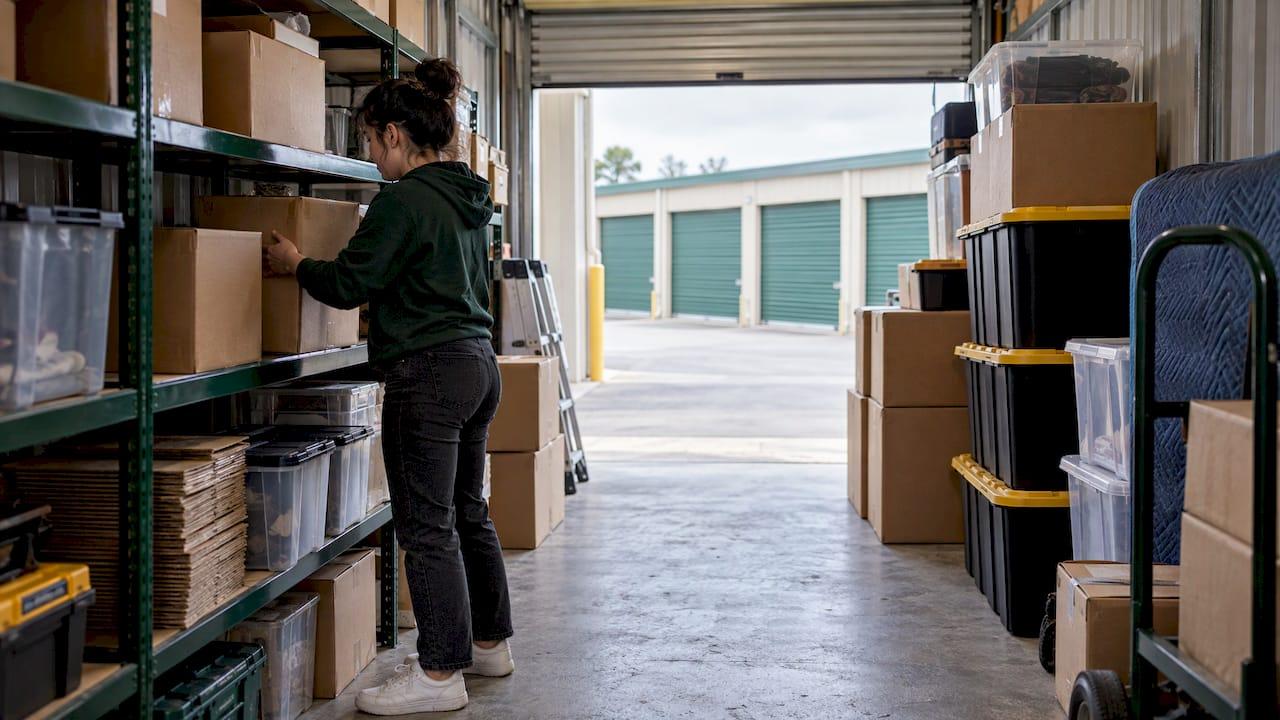
If your garage, closet or living room is losing the battle against your inventory, a month-to-month storage unit is the fastest fix. Ours are drive-up container units, seven minutes from downtown San Francisco, with 24/7 gate access, no deposit and a manager on site. You back up, load boxes, and go. No city traffic, no long contract, and rent is a flat monthly number instead of a fee on every order.
This guide walks you through picking a size, setting up your stock so you can find anything in seconds, keeping it protected, and knowing what it all costs in the Bay Area.
TL;DR
- Pick the unit by how your stock is shelved, not by how many boxes you own. Our sizes run from a 2×3 at $29 a month to an 8×40 at $399 a month.
- Drive-up access with a 24/7 gate means you can restock, grab a pallet of orders or meet a supplier delivery on your schedule.
- Label every box with product name, SKU and quantity, and leave a walkway. Cramming a unit to the ceiling slows every pick.
- Check your business or renter’s policy for stock stored off-site before you move in.
- Month-to-month with no deposit means you can grow into a bigger unit, or shrink after the holidays, without being stuck.
Table of Contents
- What ecommerce inventory storage actually is
- Who this setup suits
- Step 1: Size your space
- Step 2: Set it up so you can find anything
- Step 3: Keep your stock protected
- What ecommerce storage costs in San Francisco
- Drive-up access: why it matters when you sell online
- Ready to move your inventory out of the living room?
- A simple first-month plan
- FAQ
- Sources
What ecommerce inventory storage actually is
It’s the simple part of the chain: a safe, dry, reachable place where your products sit between the supplier and the customer. It is different from inventory management, which is the tracking (what you have, what’s selling, what to reorder), and from order fulfillment, which is picking, packing and shipping.
That split matters because it keeps your costs clear. A storage unit is a flat monthly rent. Self-storage rent is priced by facility, size and market, and there are no per-order fees because you do the picking, packing and shipping yourself. For a seller with a modest catalog, a predictable rent line is easy to budget around.
Many sellers also split the work: stock lives in the unit, orders get packed at home or at a workspace, and a few boxes at a time travel between the two. Because our unit is drive-up, that shuttle is a trunk-load or a van-load, not a parking-garage adventure.
Who this setup suits
A unit is a natural fit when:
- You’re a new or growing seller and your product is outgrowing your apartment. Shopify’s inventory storage guide calls self-storage a good match for new businesses with few products and tight budgets, with cheap space and easy access.
- You buy in bulk to get a better unit cost and need somewhere to put the pallet when it arrives.
- Your business is seasonal. Holiday goods, craft fair stock or summer apparel can sit in a unit for months, and with month-to-month terms you only pay for the stretch you need.
- You’re a student or side-hustler with a handful of products and a dorm room that is already full.
- You run a small business that also needs vehicle space. We offer secure parking stalls on the same property, so the delivery van and the inventory can live in one place.
If you just need a spot for personal belongings, same story: you pick a size, sign month to month, and go.

Step 1: Size your space
Start with how your stock is stored, then convert that to floor space. A useful formula from OrderBox’s space calculator guide is storage footprint plus work areas plus access aisles plus a buffer. The same guide warns that cubic volume is not the same as floor space: awkward shapes waste room, and trying to fill every inch of a small space leads to slower picking and more mis-picks.

In plain English: don’t ask “how many boxes?” Ask “how many shelves, and how do I get to them?”
Here’s how our sizes tend to line up with real sellers. Prices are our published monthly rents, read from our units page in September 2026.
| Unit | Monthly rent | Good for |
|---|---|---|
| 2×3 | $29 | A few bins of samples, packaging or small-batch product |
| 3×4 | $55 | A starter catalog: jewelry, cosmetics, accessories |
| 5×5 | $79 | Light shelving with a small parcel stock |
| 5×8 | $115 | A solo seller with shelves along one wall and a step-in aisle |
| 8×10 | $179 | A growing seller with shelves plus a pick-and-pack aisle |
| 8×20 | $279 | Shelving on both sides, bulk cartons, an established catalog |
| 8×40 | $399 | Pallet-scale stock, furniture, bulky goods or a seasonal blowout |
A quick worked example: say you sell candles and ship about 40 orders a week. Your stock is 30 cartons of 24 candles, plus mailers and gift boxes. Two sturdy shelving units hold the cartons off the floor, packaging goes in bins on the bottom shelf, and you want a clear path to both. That’s a comfortable 5×8 at $115 a month. When you double your catalog, you step up to an 8×10 at $179. No deposit and month-to-month means that move is a paperwork update, not a penalty.
Not sure whether a size fits your door and your stuff? Our guide to the 5x10 storage unit shows how to measure the door first, which is a good habit for any unit size.
Step 2: Set it up so you can find anything
A unit that’s messy on day one is a unit you’ll hate by month three. A few moves that pay off fast:
- Use boxes that stack. Sturdy cartons rated for stacking, with padding for fragile items, keep the bottom row from crushing. We carry boxes and moving supplies on site, so you can grab them when you pick up your keys.
- Label every box the same way. Product name, SKU and quantity, facing outward. Do this at the supplier’s box, not after it’s buried.
- Give every spot an address. Shelf A, level 2, slot 3. Write it on the box and in your spreadsheet. Now “where are the blue mugs?” is a ten-second answer.
- Keep a walkway. You should be able to reach any box without moving three others. That aisle is worth more than the extra shelf it replaces.
- Put fast sellers near the door. Slow movers go in the back. In a drive-up unit, your bestsellers are one step from the vehicle.
- Rotate stock. Oldest in front, especially for anything with a shelf life or seasonal tags.
- Keep a simple check-in, check-out log. When a unit functions like a mini warehouse, losses often come from misplacement and poor rotation as much as from outside intrusion. A clipboard or a shared spreadsheet fixes most of it.
When you finish a pick run, update your count the same day. Ten seconds now beats an oversold listing later.
Step 3: Keep your stock protected
Security for inventory comes down to who can get in, when you can get in, and what happens if something goes wrong.
Access and gate. Our property has a gate with 24/7 access, so you can restock at 6 a.m. before a shift or load orders after dinner. A manager is on site, so a real person knows the place and can help if something looks off.
Insurance. Don’t leave this one for later. Checkbook, a nonprofit consumer organization, notes that if your homeowners or renters policy covers personal property away from home, you may not need extra coverage from the facility. Business stock is a different story: renter’s policies often treat it differently from personal belongings, so call your insurance agent and ask specifically whether inventory in a storage unit is covered, and at what limit. Then read our self storage insurance guide for what you need and what you can skip.
Lock and door. Use a quality lock and keep your unit number and access code off your shipping labels and social posts.
Storage period. Planning to hold stock for three months or more? Our guide on when climate controlled storage pays helps you think through what your goods need.

What ecommerce storage costs in San Francisco
The Bay Area is one of the pricier storage markets in the country, so the rent is the line to check first. Checkbook’s undercover survey of Bay Area facilities found that small units averaged about $105 a month, and a 10-by-20-foot unit averaged $360 a month. It also advised shoppers to watch for one-time administration or setup fees and to check access hours, since some facilities aren’t open around the clock.
That gives you a good shopping list. When you compare any storage option, ask:
- What is the monthly rent for the size, and what other fees apply on day one?
- Is there a deposit?
- What are the access hours?
- Is the term month to month?
- Can I drive right up to the door?
On our side, the answers are short: month-to-month, no deposit, a 24/7 gate, and drive-up units. Rents are posted on our units page, from $29 a month for a 2×3 to $399 for an 8×40. Because rent is flat, your cost per order drops as your sales rise, and your storage line stays the same on a busy December as on a slow February.
For comparison, warehousing services that handle fulfillment typically charge by the pallet and the order. One 2026 cost model put pallet storage at roughly $18 to $25 per pallet per month, with receiving fees and setup fees on top. With a unit, your rent is one number you can write on a sticky note.
Drive-up access: why it matters when you sell online
Most online sellers know the pain: a supplier shipment lands on a day you have no help, the boxes are heavy, and the elevator is down the hall and slow. Drive-up changes the math.
- Receiving. A van or truck backs up and unloads straight into the unit.
- Restocking. You carry cartons from the trunk to the shelf, not through lobbies and hallways.
- Pop-up and market runs. Load Friday night, sell Saturday, return Sunday.
- Bulk moves. Need a bigger vehicle once in a while? We rent U-Haul trucks on site, from $19 per day.
If your business also needs a place for a delivery van, trailer or work truck, our vehicle parking runs in 11×30, 11×40 and 11×66 stalls at $299, $399 and $599 a month, with multi-vehicle discounts available.
Our take
I talk to sellers all the time who are about to sign something bigger than they need, or who are paying a hefty rent for a space they only visit twice a week. Here’s what I’d tell any of them.
Start with the smallest unit that holds your shelves and leaves you a walkway. Our month-to-month terms and no deposit mean that if you guess wrong, you step up a size without any drama. That’s the whole point of how we run things.
The other thing we hear: location beats everything. We’re seven minutes from downtown San Francisco with no city traffic, and you can drive right up to your door any hour of the day. For a seller who is shuttling boxes between a unit and a kitchen table, that saves real time every week.
Keep it simple, label everything, and don’t fill the unit to the ceiling. You’ll thank yourself in November.
Mike
Ready to move your inventory out of the living room?
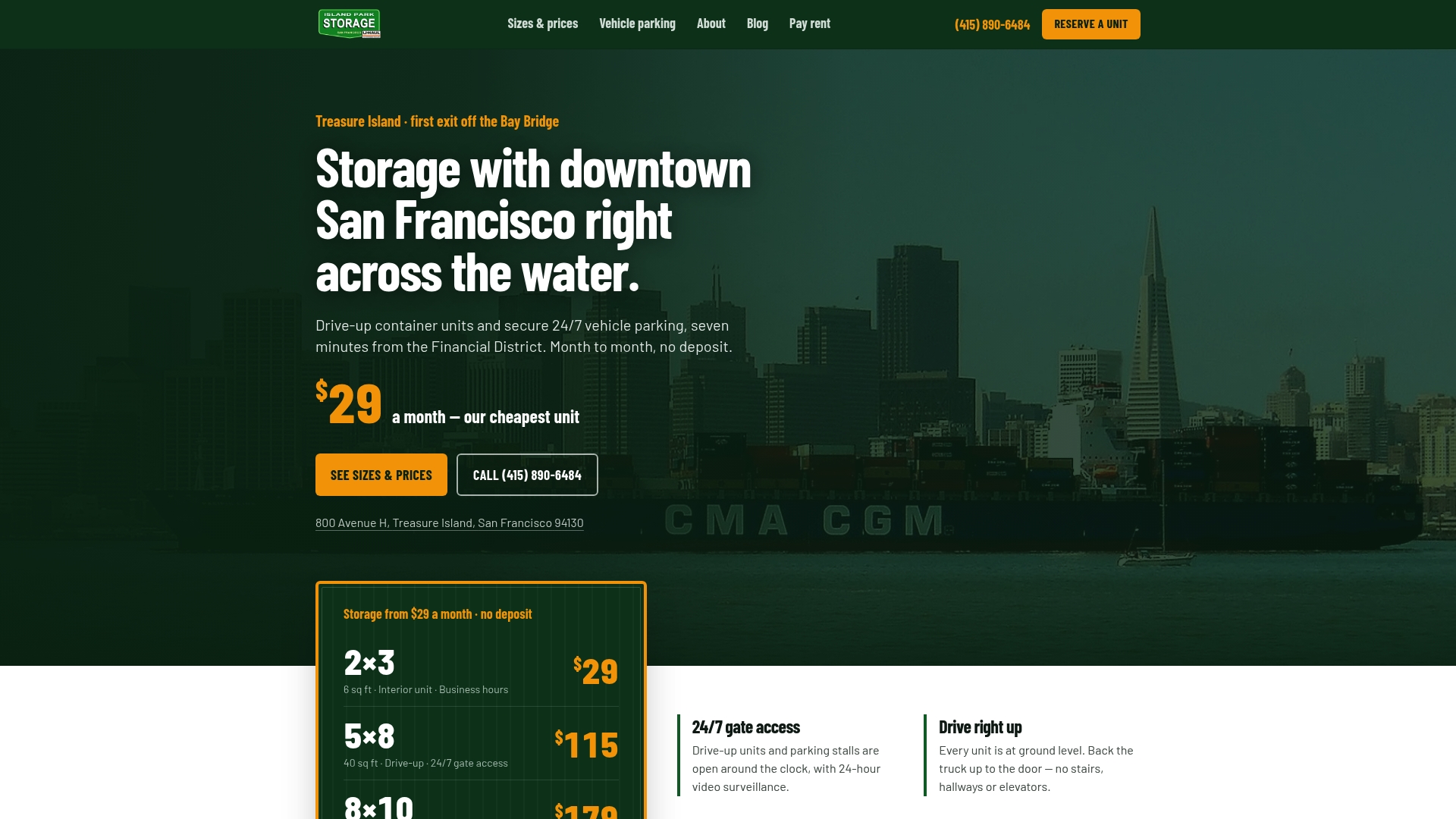
We have seven self-storage sizes, from a 2×3 at $29 a month to an 8×40 at $399 a month, all month-to-month with no deposit. Our manager is on site and the gate is open 24/7. Check the sizes and current rents on our units page, or pick up boxes and moving supplies when you come by.
If you have questions about the right size for your catalog, stop by and talk to our on-site manager, who can help you match shelves to square footage.
A simple first-month plan
A good first month looks like this:
- Week 1: Count your stock by SKU and measure your shelving. Choose the unit size from the table above.
- Week 2: Reserve the unit, buy sturdy boxes and a lock, and call your insurance agent about business stock.
- Week 3: Move in. Shelf the fast sellers by the door, label every box, and start your log.
- Week 4: Run a full cycle: receive a shipment, pick orders, update counts. Fix whatever felt clunky.
After that, review once a quarter. If you’re stepping around boxes, go up a size. If the unit’s half empty after the holidays, drop down. That flexibility is what month-to-month is for.
FAQ
Can I store ecommerce inventory in a self-storage unit?
Yes. Our units work for individuals and small businesses, including people who need space for inventory. Shelve your stock, keep a clear aisle, and keep your orders packing and shipping in a separate workspace of your own.
What size unit do I need for my online store?
It depends on your shelving, not just your box count. A 5×8 at $115 a month suits a solo seller with a modest catalog, an 8×10 at $179 gives you room for a pick aisle, and an 8×20 at $279 fits an established catalog with shelves on both sides. You can move up a size when you grow.
Do I need insurance for inventory in storage?
Check first with your insurance agent. Some homeowners or renters policies cover personal property away from home, but business stock may be treated differently, so ask directly about inventory and the coverage limit. Our insurance guide explains what to look for.
Is there a deposit or long contract?
No. Every rental with us is month to month with no deposit required, so you can start small and change sizes as your business changes.
Can I get in at night or on weekends?
Yes. Our gate offers 24/7 access, and our units are drive-up, so you can load and unload when it suits your schedule.
Sources
- Checkbook: Self-Storage Facilities, San Francisco Bay Area
- Shopify: Inventory Storage Options, Systems, and Tips
- OrderBox: Warehouse Space Calculator Guide for Ecommerce
- SmartStorage.pro: Secure Storage Unit Checklist
- SelfStorageCost.com: Business Inventory Storage Cost 2026
- Sellerboard: FBA vs. AWD vs. 3PL cost model
- EasyDeal USA: Small Business Inventory Storage Guide