
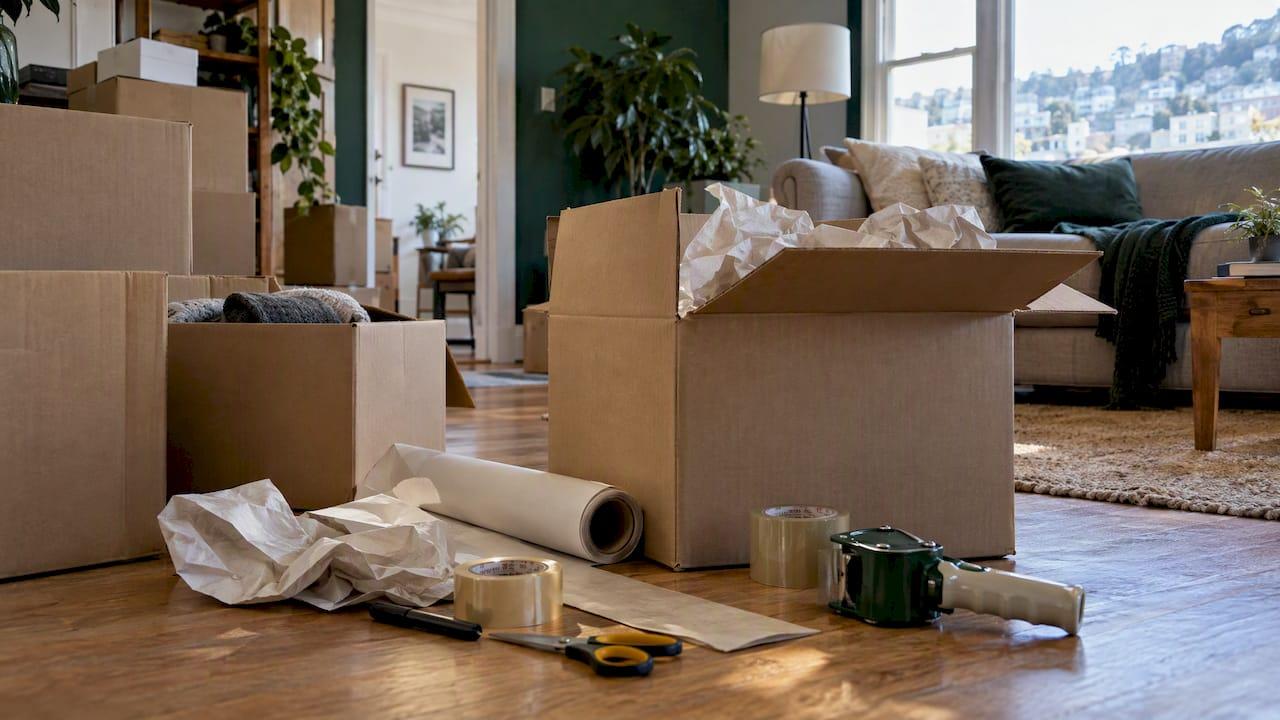
Here’s the short version of a moving supplies checklist: sturdy boxes in a few sizes, heavy-duty tape and a tape gun, packing paper and bubble wrap, markers and labels, box cutters, a dolly, and a first-night essentials box. Add a few extras if your stuff is headed to a storage unit. The rest of this page tells you how much of each to buy, what you can skip, and how to do it without losing your mind.
We run a self-storage facility minutes from downtown San Francisco, so we watch people load up cars, vans and U-Haul trucks every day. The ones who have the right supplies on hand before they start have a much easier time. The ones who run to the store three times mid-pack do not.
TL;DR
- Core kit: assorted sturdy boxes, heavy-duty tape plus a tape gun, packing paper, bubble wrap, permanent markers, labels, scissors or a box cutter.
- Moving day kit: dolly, furniture pads or blankets, stretch wrap, straps, and an essentials box that rides with you, not in the truck.
- Plan roughly one roll of tape per 15 to 20 boxes, and use Angi’s box estimates to size your order.
- Heading to storage? Add breathable covers, something to keep items off the floor, and uniform boxes that stack.
- Save money by decluttering first and borrowing soft goods like towels as padding.
Table of Contents
- The core packing kit
- Moving day supplies
- Packing supplies list, room by room
- How many boxes do you need?
- Boxes or bags?
- Supplies for storage
- Where to get supplies and how to save
- What we’d tell a friend
- Grab your supplies and your space in one stop
- A simple packing timeline
- Mistakes to dodge
- FAQ
- Sources
The core packing kit
These are the items every move needs, whether you’re packing a studio or a three-bedroom house. Buy them before you pack the first shelf.
Boxes in three sizes
Plan on small, medium and large boxes. The rule that saves backs: heavy things go in small boxes, light things go in big ones. Books in a large box is how you end up with a box nobody can lift.
| Box size | Best for | Don’t use it for |
|---|---|---|
| Small | Books, canned goods, tools, records | Anything bulky and light |
| Medium | Kitchen items, toys, small appliances, general stuff | Heavy dense items |
| Large | Pillows, bedding, lampshades, stuffed animals | Anything that adds up to a heavy load |
We wrote a whole guide on U.S. moving box sizes and the 40 to 50 pound packing rule if you want the numbers behind that table.
Then add specialty boxes where they earn their keep:
- Wardrobe boxes for hanging clothes, so you skip the fold-and-wrinkle step.
- Dish-pack boxes with dividers for plates and glasses.
- TV and mirror boxes for flat, fragile things.
Tape and a tape gun
Cheap tape is the thing people regret most. Wirecutter’s moving guide says good tape and a tape gun are essential, with about one roll per 15 to 20 boxes. The same guide notes that poor tape and mismatched containers make a move slower and more physically draining. So buy heavy-duty packing tape, not the stuff from your desk drawer.

A tape gun costs little and saves your wrists. It’s one of those small upgrades you’ll thank yourself for around box number forty.
Padding: paper, bubble wrap and soft goods
You need something between your fragile stuff and the world.
- Packing paper wraps plates, bowls and glassware. It’s clean, flexible and easy to recycle. Wirecutter points to packing paper and honeycomb wrap for dishes and glasses, with bubble wrap as a safety measure for delicate items.
- Bubble wrap is for the things you’d cry over: picture frames, a favorite vase, electronics.
- Stretch wrap holds drawers shut, bundles loose items and keeps pads on furniture.
- Your own soft stuff works too. Towels, linens and sweaters are free padding that you have to pack anyway.
One habit to steal: fill every gap in a box. Items that can shift will shift. Crumpled paper or a folded towel on top is enough.
Markers, labels and a notebook
Labeling feels like a chore until unpacking day. Angi recommends labeling boxes on at least two sides with the contents and the destination room. Here’s the simple system we like:
- Use a fat permanent marker, not a ballpoint.
- Write the room on two sides and the top.
- Add “FRAGILE” or “THIS SIDE UP” where it matters.
- Keep a numbered list in a notebook or your phone of what’s in each box.
Colored tape or stickers per room is a bonus. Your helpers can sort boxes without asking you forty questions.
Cutting and measuring tools
- Scissors or a box cutter (keep it somewhere you can find it, not buried in box 12)
- A measuring tape, so you know if the sofa clears the door and if the dresser fits the stairwell
- A basic toolkit: screwdrivers, an Allen key set, a hammer, zip ties
- A few zip-top bags for screws and hardware, taped to the furniture they belong to
Moving day supplies
Packing is half the job. Getting boxes and furniture from A to B without injury or dents is the other half.
Gear for lifting and loading
- Dolly or hand truck for stacks of boxes and heavy appliances
- Furniture sliders for dragging heavy pieces across floors without gouging them
- Lifting straps so two people can handle awkward, heavy items
- Furniture pads or moving blankets to protect wood, corners and finishes
- Ratchet straps or rope to hold the load against the wall of the truck
- Mattress bags to keep beds clean
- Gloves because boxes bite
If you’re renting a truck, we offer U-Haul truck rentals on site, starting from $19 per day. You can grab the truck and the boxes and moving supplies in one stop. Skip the hardware-store scavenger hunt.
The essentials box
Pack one box that never goes on the truck. It rides in your car, or in your hands. Angi’s checklist suggests including first-day needs such as:
- Toiletries and any medications
- Phone chargers
- Basic tools
- A change of clothes
- Important documents
We’d add toilet paper, a towel, a roll of trash bags, a cooler with water and snacks, and a coffee mug. Humor us: you’ll want the coffee.
Cleaning supplies
Movers and landlords both notice a dirty place. Have a broom, dustpan, sponges, paper towels, trash bags, a mop and an all-purpose cleaner on hand for the empty old place and the not-yet-unpacked new one. Keep them out of the truck until the last minute, since you’ll need them before you leave.
Packing supplies list, room by room
Not sure what to buy for which room? Here’s a quick way to think about it.
| Room | What to have |
|---|---|
| Kitchen | Packing paper, dish-pack boxes, small boxes for cans, bubble wrap for glasses, tape |
| Bedroom | Wardrobe boxes, large boxes for bedding, mattress bag, stretch wrap for drawers |
| Living room | Furniture pads, TV box or bubble wrap, medium boxes for décor, stretch wrap |
| Office | Small boxes for books and files, zip ties for cables, bubble wrap for monitors |
| Garage and closets | Sturdy small boxes for tools, heavy-duty tape, labels, gloves |
| Bathroom | Zip-top bags, medium boxes, towels as padding |
Start with the rooms you use least and finish with the kitchen and bathroom. Pack a “first week” bag for the last few days so you aren’t digging through sealed boxes.
How many boxes do you need?
Everyone underestimates this. Angi estimates about 10 to 35 boxes for a studio and 140 to 180 for a five-bedroom house, and notes your total depends on what you own and who lives with you. That’s a big range, so use it as a starting point.
A few ways to tighten your number:
- Declutter first. Every item you donate or toss is one less thing to box.
- Count by room, not by the whole place. Kitchens and closets eat boxes.
- Buy a little extra. Returning unused boxes is easier than a midnight supply run.
- Do the tape math. Using the one-roll-per-15-to-20-boxes guide, a 100-box move needs five to seven rolls.
We suggest ordering about 10 percent more than your estimate, plus a few extra medium boxes. They’re the ones that end up everywhere.

Boxes or bags?
A common question: do movers prefer boxes or bags? Boxes win. Wirecutter’s guidance is to use uniform, sturdy cardboard boxes rather than a mix of luggage and trash bags, because they stack efficiently and lower the risk of damage in transit. Bags tear and don’t protect anything.

Bags still have a role. Soft clothes and bedding can go in a duffel or a large bag if you’re moving a short distance, and trash bags are great for the last-minute stuff you’d otherwise carry loose. Just don’t build a load out of them.
Supplies for storage
If your move includes a storage unit, a few extra supplies keep your stuff in shape while it sits.
- Uniform boxes that stack. Square, same-size boxes use a unit’s space far better than a mix of odd containers.
- Breathable covers for furniture, such as cotton sheets or fabric covers. We steer people away from plastic wrap on upholstered pieces for long stays, since it can trap moisture.
- Pallets or risers so nothing sits straight on the floor.
- Silica gel packets tucked into containers with electronics or metal items, to help with moisture.
- Durable plastic bins for things you’ll grab often, with labels facing the aisle.
- A padlock for your unit.
A few layout habits help too. Leave a walkway down the middle so you can reach the back. Put the heavy, rarely used stuff at the back and the things you’ll need soonest near the door. Keep a simple inventory list taped inside the door or saved on your phone.
Clothing deserves special care. Our guide to long-term clothing storage covers how to do it right. For fabrics and keepsakes that need gentler handling, see our post on storing holiday decorations and heirlooms. If you plan to be in storage for three months or more, our breakdown of when climate-controlled storage pays off will help you decide.
Where to get supplies and how to save
Buying everything new gets expensive fast. Here’s how to trim it without cutting corners on the stuff that matters.
- Declutter before you buy. Fewer things, fewer boxes, less tape.
- Hunt for free boxes. Local shops and community groups often have used boxes to give away. Use sturdy ones with no water stains, and reinforce the bottoms with tape.
- Use soft goods as padding. Towels, blankets, linens and clothes cushion fragile items for free.
- Rent reusable bins if you’re moving locally and have somewhere to return them.
- Spend where it counts. Tape, wardrobe boxes and dish-pack boxes are worth buying new.
There’s an eco angle too. Consumer Reports estimates American moves generate about 900 million cardboard boxes and 8.4 million tons of waste each year, and it points to reusing containers and renting bins as better choices. Reusing boxes saves you money and helps with that number.
For city moves, you can also cut down on truck costs. If your load is four or more car loads, our post on moving without a truck in the city lays out how to handle it.
What we’d tell a friend
Perspective from the team
Most people think the hard part of a move is the lifting. We see it differently. The hard part is the gaps: the day your boxes run out at 9 p.m., or the day you realize your couch has nowhere to go for two weeks.
That’s why we built Island Park Storage the way we did. Our units are true drive-up, with 24/7 gate access, so you can pull up, unload at your own pace and come back whenever you need something. Rentals are month-to-month with no deposit required, so you aren’t locked in while your plans shift. And there’s a manager on site who’ll help you pick a size instead of guessing.
We’re seven minutes from downtown San Francisco with no city traffic to fight. That matters when you’re shuttling boxes in a loaded car. We also sell boxes and moving supplies and rent U-Haul trucks right here, so you can get the kit and the space in one trip.
Our advice: buy your supplies first, pack one room at a time, and don’t be shy about putting overflow in storage. A little breathing room makes the whole move calmer.
Mike
Grab your supplies and your space in one stop
If you’re packing for a move, a student summer or a business inventory overflow, we can cover the whole checklist from one spot. We carry boxes and moving supplies, rent U-Haul trucks, and offer self-storage in sizes from a 2×3 for $29 per month up to an 8×40 for $399 per month. Month-to-month, no deposit required.

Not sure what size you need? Peek at our self-storage unit sizes and prices. A 5×5 is $79 per month, and we even wrote up whether a 75-inch mattress fits in a 5×5. Got a car, RV or boat to park? Check our vehicle parking options, starting with an 11×30 space at $299 per month. Indoor motorcycle storage is $115 per month. Prefer to see it first? Reserve a unit and swing by.
A simple packing timeline
Supplies are only useful if you use them in a sane order. Here’s a rough timeline you can adjust.
- Four to six weeks out: Declutter. Order or pick up your boxes, tape, paper and markers. Decide whether any of it is going to storage.
- Three weeks out: Pack the rooms and things you rarely use: off-season clothes, books, wall art, spare linens.
- One to two weeks out: Pack the kitchen gradually, leaving out a few dishes and a pan. Disassemble furniture and bag the hardware.
- Two days out: Pack the bathroom and bedroom. Fill your essentials box. Wrap furniture in pads and stretch wrap.
- Moving day: Load heavy items first, boxes in even stacks, soft stuff in the gaps, and strap everything down.
If you hit a snag and your new place isn’t ready, storage solves it. Put the overflow in a unit for a month or two and keep going.
Mistakes to dodge
- Overstuffing boxes. If the lid bulges, it’s too full.
- Mixing weights. A heavy item on top of light ones crushes them. Put heavy at the bottom.
- Skipping labels. Future you will not remember what’s in the mystery box.
- Using weak tape. It’s the cheapest thing to upgrade.
- Forgetting the essentials box. You’ll be hunting for a phone charger at midnight.
- Buying everything at once. Start with the core kit, then add as you go, and keep your receipts for returns.
FAQ
What are the must-have moving supplies?
Start with sturdy boxes in assorted sizes, heavy-duty packing tape and a tape gun, packing paper, bubble wrap, permanent markers and scissors or a box cutter. For moving day, add a dolly, furniture pads and straps. Those cover almost every move, and you can add specialty boxes for clothes, dishes and TVs as needed.
What should you pack first when moving?
Pack the stuff you use least: off-season clothes, books, decor, extra linens and anything in closets or the garage. Leave the kitchen, bathroom and daily clothes for the last few days. Pack your essentials box last, and keep it with you.
How many boxes do I need for a one-bedroom apartment?
Angi gives a range of roughly 10 to 35 boxes for a studio and 140 to 180 for a five-bedroom house, so a one-bedroom lands somewhere between those. Your exact number depends on how much you own. Count room by room, declutter first, and buy a few extra.
Do movers prefer boxes or bags?
Boxes. They stack evenly, protect what’s inside and make loading faster, while bags can tear and don’t hold their shape. Use bags only for soft items or last-minute leftovers.
What supplies do I need for packing a storage unit?
Uniform boxes that stack, breathable furniture covers, pallets or risers to keep items off the floor, silica gel packets for sensitive items, labels and a padlock. Leave a walkway so you can reach everything, and keep a written inventory.
Sources
- The Ultimate Moving Supplies List | Angi
- How Many Boxes Do I Need to Move? | Angi
- The Best Supplies and Packing Advice for Making Moving Less Miserable | Wirecutter
- Make Your Next Move More Sustainable | Consumer Reports