
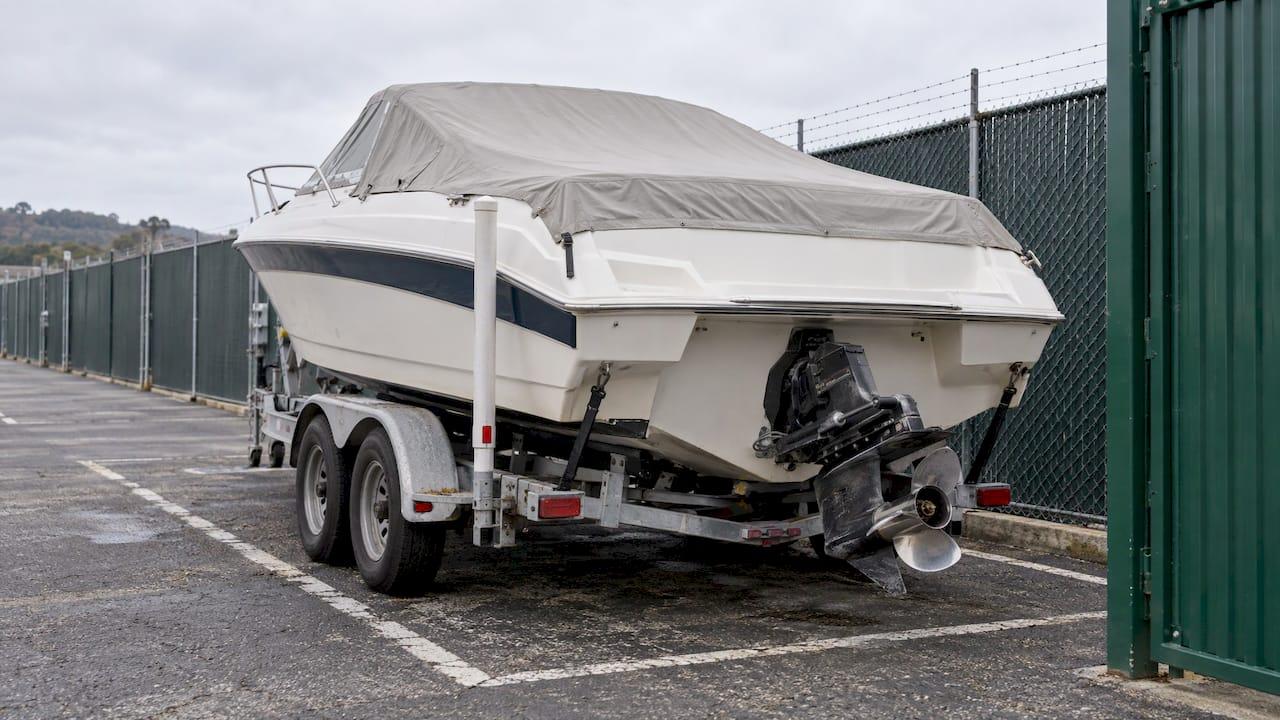
The short version: drain it, cover it, park it somewhere you can get to. A boat that goes into winter storage dry, with the engine winterized and a breathable cover, comes out in spring ready to go. We rent month-to-month vehicle parking stalls seven minutes from downtown San Francisco, with 24/7 gate access and no deposit. That means you can park the boat, check on it whenever you like, and stop paying the month you launch it again.
Below is the whole routine, from the hull to the outboard to the cover, plus what each storage setup costs with us.
TL;DR
- Start dry. Drain the engine, tanks, plumbing and hull before anything else, because trapped water is what does the damage.
- Winterize even in mild San Francisco. Many insurance policies won’t cover freeze damage unless the boat’s systems are winterized.
- Use a breathable, well-supported cover. Skip cheap poly tarps, and leave airflow so mildew doesn’t move in.
- Our boat-size parking stalls run $299, $399 or $599 a month, month to month, no deposit, with 24/7 gate access.
- Smaller gear (outboard accessories, cushions, life jackets) fits in a self-storage unit starting at $29 a month.
Table of Contents
- Why a “mild” Bay Area winter still needs a plan
- Pick your storage setup
- Step 1: Start with a clean, dry boat
- Step 2: Drain everything that can hold water
- Step 3: Winterize the outboard engine
- Step 4: Choose and fit the cover
- Step 5: Get it on a trailer or stands properly
- Step 6: Visit now and then
- Step 7: Spring recommissioning
- Park it with us
- Our take
- FAQ
- Sources
Why a “mild” Bay Area winter still needs a plan
San Francisco doesn’t get the deep freezes of the Great Lakes. So it’s tempting to throw a tarp on the boat and call it a day. Don’t.
Two things work against you here: damp and the occasional cold snap. Boats that sit under a cover without airflow trap moisture, and moisture means mildew. Mercury Marine’s winter storage guidance puts ventilation and a dry, covered boat at the center of the job for exactly that reason, since condensation under a cover leads to mold and mildew.
Then there’s freezing. Water left in an engine block or a plumbing line can crack parts if one cold night shows up. BoatUS recommends winterizing regardless of where you store, so you’re covered if a winter storm knocks out power or heat at the storage site. It also points out that many policies won’t pay for freeze damage if the vessel wasn’t winterized. Do the work once and you’re covered on both fronts.
Pick your storage setup
Before you grab a wrench, decide where the boat will sit. That choice drives everything else, like the cover you need and how often you’ll check in.
Mercury Marine calls a garage the ideal spot. Most of us in the city don’t have one, and a boat on a trailer doesn’t fit in a studio apartment’s parking spot anyway. The realistic options are:
- Outdoor on-land storage. The boat sits on its trailer or stands, under a proper cover. BoatUS says the cover choices include tarps, shrink wrap or custom canvas enclosures, and the minimum is a cover that’s strong, breathable, water-resistant and ventilated.
- Indoor storage. Great protection, but spaces are limited and usually cost more.
- In the water. Fine for some boats, but it comes with its own winterizing to-do list, and it isn’t what most people searching for storage have in mind.
For most trailer boats, a secure outdoor parking stall plus a good cover is the simplest, most affordable setup. That’s what our vehicle parking is for.
What our parking stalls look like
Our vehicle and boat parking comes in three stall sizes. Pricing below is as published on our site, per month:
| Stall size | Monthly price |
|---|---|
| 11×30 | $299 |
| 11×40 | $399 |
| 11×66 | $599 |
The first number is the width of the stall and the second is its length, in feet. Measure your boat on its trailer from the tip of the bow or tongue to the back of the outboard or trailer, and add the width of the widest point. Then pick the smallest stall that clears it with room to walk around. If you’re not sure, our on-site manager is happy to help you size it up.
Every rental is month to month. No deposit, no long contract. If winter turns out to be four months for you, you pay for four months.
Want more on trailers? Our guide to boat trailer storage costs and prep covers the trailer side, and our post on boat storage options goes deeper on parking choices.
Step 1: Start with a clean, dry boat
Mercury Marine’s advice starts with a dry boat. Wash it, then let it dry fully before you cover it. Anything wet you seal in becomes a mildew farm by February.
While you’re at it, take everything out that you don’t want to freeze, grow mold or tempt a thief: cushions, life jackets, electronics, loose gear, fishing tackle, food. That pile is going to need a home. A self-storage unit is an easy answer. Our units run from $29 a month for a 2×3 up to $399 for an 8×40, and the full list is on our self-storage units page:
| Unit size | Monthly price |
|---|---|
| 2×3 | $29 |
| 3×4 | $55 |
| 5×5 | $79 |
| 5×8 | $115 |
| 8×10 | $179 |
| 8×20 | $279 |
| 8×40 | $399 |
For a typical boat’s worth of soft gear, a 3×4 or 5×5 is often plenty. Life jackets, cushions and canvas pieces store best dry, so keep them off the floor.

Step 2: Drain everything that can hold water
This is the step that matters most. Mercury Marine’s list of systems to drain is long: engine and propulsion systems, freshwater and sanitation tanks, plumbing, and the hull itself. A few specifics from their guidance:
- Tilt outboards down so the cooling passages drain.
- Pull the drain plugs and raise the bow slightly so water runs out.
- Run raw-water accessories with pumps, like livewells and washdowns, until the water is gone. If you still hear gurgling, blow the lines out with compressed air or use environmentally safe propylene glycol antifreeze.
Ohio’s Department of Natural Resources gives the same basic advice in simpler form: drain the bilges and leave the transom drain plug out during storage, and check your owner’s manual for brand-specific tips. Good habit: tie the plug to the steering wheel or the key so you can’t forget it in spring.
Step 3: Winterize the outboard engine
Outboards get their own section because that’s what people search for most after the storage question itself. The exact procedure depends on your engine, so keep your owner’s manual open. Here’s the common outline that the major manufacturers agree on.
Stabilize the fuel
Fuel goes stale. Crowley Marine says untreated gas can go bad in a few weeks, and recommends adding a fuel conditioner and running the engine for a few minutes so treated fuel reaches the whole system. Yamaha suggests keeping the tank about 7/8 full of stabilized fuel to limit condensation, and says never to plug or cap the tank vent.
Flush and drain the cooling system
West Marine’s routine is to flush the cooling system with fresh water using flushing muffs on a garden hose, then run the motor a few minutes to warm the oil. After that, it recommends flushing with non-toxic propylene glycol antifreeze rather than just draining, so no residual water is left to freeze in a hard cold snap.

Change the oil
West Marine also advises draining the engine oil and refilling it fresh before storage, since acids, moisture and combustion byproducts in used oil can corrode parts over a long layup. On a four-cylinder Yamaha, the maker’s steps also include changing the lower-unit gear lube. Look at the old lube: a milky look suggests water got in past a seal, and metal bits suggest seal damage. Also pull the propeller and check for fishing line wrapped around the shaft, and grease the prop shaft with marine grease.
Fog the cylinders
Fogging oil coats the inside of the engine so it doesn’t rust while it sits. Mercury Marine says that on four-stroke and conventional two-stroke engines you ideally do this while the motor is still warm: remove the spark plugs and spray fogging oil into each cylinder. DFI two-strokes are different. Mercury says to squirt one ounce of DFI outboard oil into each cylinder through the spark plug hole instead.
Yamaha says its recommended fogging covers any storage longer than a month and takes about 15 minutes: warm the engine, stabilize the fuel, fog the intake until the engine sputters out, then fog each cylinder for a few seconds and turn the flywheel by hand to spread the oil before reinstalling the plugs. Crowley Marine adds a nice safety touch: leave the spark plug leads off during storage so the engine can’t be started by accident.
Don’t forget the battery
A battery left alone all winter can go flat for good. Take it out, keep it somewhere dry, and keep it charged with a maintenance charger. A small unit in a self-storage unit with a trickle charger setup can work if you have power access you control; at home, a shelf in a closet does the trick.

Step 4: Choose and fit the cover
The cover is where a lot of boaters either save money or lose it. Here’s what the experts say.
- Skip cheap poly tarps. Mercury Marine warns against inexpensive ones.
- Canvas works if it’s supported. It has to carry the weight of snow and ice, which in San Francisco mostly means rain pooling on a sagging cover.
- Shrink wrap seals everything out. A pro applies it, and it works for outdoor storage.
- Semi-custom covers. BoatUS Foundation reports they offered the best balance in its tests, and says custom covers are a better investment if you’ll own the boat for years.
Whatever you choose, build a frame under it. BoatUS says a sturdy framework helps the cover last longer, sheds water and ice more easily, and cuts down flapping in the wind that can rub hull finishes. Then leave airflow. BoatUS Foundation says boats need to breathe under cover; a tight cover needs vents, and you should check that it has one for the outboard.
Think of it like a jacket. Waterproof but zero airflow, and you’re sweaty and miserable. Same with your boat.
Step 5: Get it on a trailer or stands properly
Support matters. Make sure the weight sits on the trailer’s bunks or rollers as designed, and that the tires are inflated. If you take the boat off the trailer onto stands, ask a yard to place them, since improvised supports are a common source of new damage. Check the trailer lights, bearings and tires now, so the first spring trip isn’t a surprise. Park with the bow slightly raised so water that gets in finds the drain plug.
Step 6: Visit now and then
This is where 24/7 gate access earns its keep. A boat in winter storage isn’t a set-it-and-forget-it item. Every few weeks, especially after a storm:
- Look at the cover for pooled water, loose straps or chafe points.
- Make sure the vents are still clear.
- Confirm the drain plug is still out.
- Peek inside for any signs of damp or pests.
The guidance from BoatUS Foundation on vents and secure straps implies exactly this: a cover is a system you maintain, not something you can ignore. Our gate is open day or night, so you can swing by after work or on a Saturday morning without needing to coordinate with office hours.
Step 7: Spring recommissioning
When the weather turns, reverse the checklist. Reinstall the battery, refit spark plugs and leads, replace the drain plug, check fluids, inspect hoses and belts, and test the engine in a bucket or on the water at low load first. Your insurer or your owner’s manual may add steps for your model.
Because our parking is month to month, you can leave the day you’re ready, with no penalty for ending early.
Park it with us
If you’re wondering where to put the boat for the winter without signing up for something long, this is what we built our parking for. Our stalls are 11×30 at $299, 11×40 at $399 and 11×66 at $599 per month. Rentals are month to month with no deposit, the gate is open 24/7, and the facility is seven minutes from downtown San Francisco without the city traffic. Multi-vehicle discounts are available if you have a boat and a tow vehicle or a second rig. Our manager is on site and can help you pick a size. If you need a trailer pulled, we also have U-Haul truck rentals from $19 a day.

Prefer to see the numbers for gear too? Browse our self-storage units and reserve what fits. We also keep boxes and moving supplies on hand, so you can pack up your cushions and gear in one trip.
Our take
Most of the boat owners we talk to aren’t worried about the big stuff. They’re worried about the little stuff they forgot to deal with: a drain plug, a battery, a cover that fills with rain.
So here’s how we look at it. Winterizing is a weekend of work. Where the boat sits is a monthly decision. We set up our parking so that second part is easy: month to month, no deposit, 24/7 gate access, and a manager on site who knows your name.
Pick the right stall size, put the engine to bed properly, cover the boat with something that breathes, and come check on it when you want. That’s it. You don’t need to lose your mind over it.
Mike
FAQ
Do I really need to winterize my boat in San Francisco?
Yes. Winters here are mild, but a cold night can still damage a boat that has water trapped in the engine or plumbing. BoatUS also notes that many insurance policies won’t cover freeze damage unless the vessel’s systems are winterized, so check your policy.
How do I store an outboard engine for winter?
Stabilize the fuel, flush the cooling system, change the oil and lower-unit lube, and fog the cylinders. Tilt the motor down so it drains, and follow your owner’s manual for your exact model. Fogging is recommended by Yamaha for any storage longer than a month.
What’s the best cover for winter storage?
Choose something strong, breathable and water-resistant, on a frame so it sheds rain and doesn’t flap. Mercury Marine says to avoid inexpensive poly tarps, and BoatUS Foundation found semi-custom covers offered the best balance. Whatever you use, add vents so moisture can escape.
Can I park my boat with you month to month?
Yes. Our vehicle parking stalls are rented month to month with no deposit, in 11×30, 11×40 and 11×66 sizes at $299, $399 and $599 a month. The gate is open 24/7, so you can visit your boat any time.
Sources
- Mercury Marine: How To Store Your Boat for Winter
- Mercury Marine: How to Winterize Your Outboard
- BoatUS: Winter Boat Storage Options
- BoatUS Foundation: Boat Covers for Winter Storage
- Ohio DNR: Winterizing Your Boat
- Yamaha Outboards: Extended Storage
- Yamaha Outboards: Winterize Your 4-Cylinder Outboard
- West Marine: Winterizing Your Outboard Motor
- Crowley Marine: Off-Season Storage
- Yamaha Online Parts: Fogging Oil Best Practices