
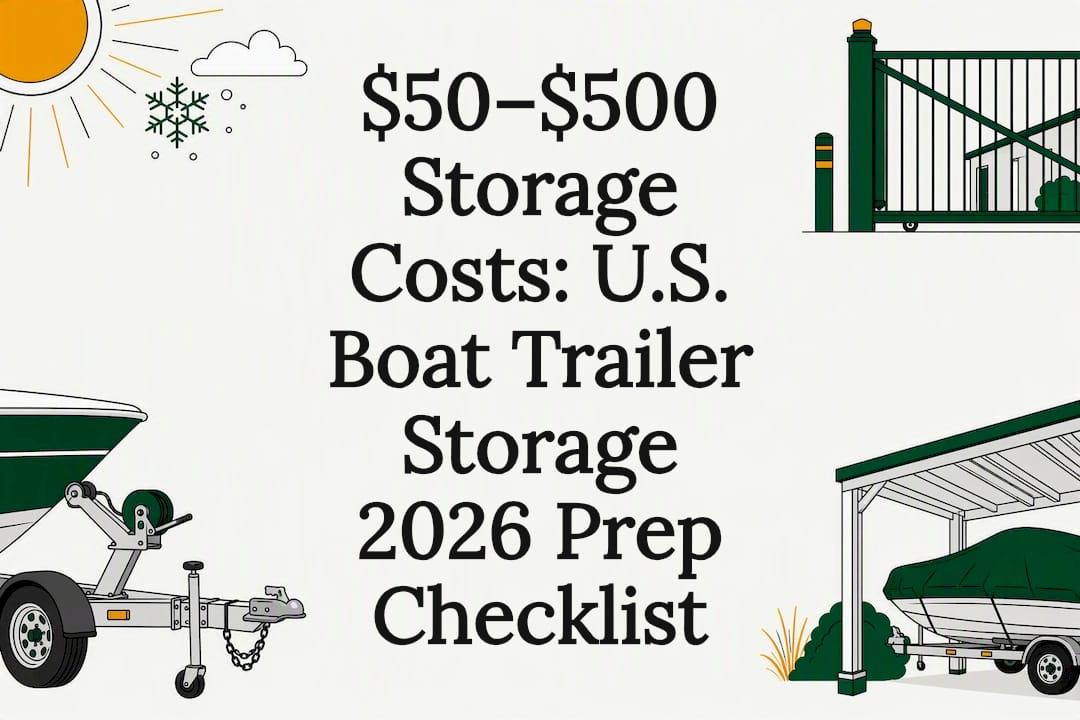
For most trailer-stored boats, outdoor uncovered parking is the right call. It’s the most affordable option and works fine for everyday fishing boats and pontoons. Bump up to covered storage if you’re worried about UV and salt damage, and go enclosed or dry-stack if you own a high-value boat or use it often enough that quick access matters more than saving a few bucks a month.
TL;DR:
- Outdoor uncovered parking is the cheapest option at $50–$150 per month and provides quick access, but offers minimal UV and weather protection.
- Covered storage costs $100–$250 per month and protects against sun and rain while maintaining easy access for long-term storage.
- Enclosed indoor storage is the most expensive, usually $200–$500 monthly, and is ideal for high-value boats or harsh winter conditions, but it offers slower access.
- Proper trailer prep, including rinsing saltwater hubs and checking bearings, can significantly reduce repair costs in spring, saving hundreds of dollars.
- Storing in a facility with 24/7 access and measuring your trailer’s overall length ensures proper fit and convenience, avoiding costly overlength charges or limited access issues.
Table of Contents
- Boat Trailer Storage Options: Outdoor, Covered, Enclosed, and More
- What Does Boat Trailer Storage Cost?
- How Do You Prep a Boat Trailer for Storage?
- How Do You Choose the Right Storage Facility?
- Seasonal Storage Considerations and Weather Protection
- What Legal and Insurance Requirements Apply to Boat Trailer Storage?
- Environmental Rules and Best Practices for Boat Trailer Storage
- How Accessible Is Your Stored Boat Trailer?
- Island Park Storage’s Take on Matching Storage to How You Actually Use Your Boat
- Ready to Book? Measure Your Rig and Check Stall Sizes
- Sources
- FAQ
Boat Trailer Storage Options: Outdoor, Covered, Enclosed, and More
Not all boat trailer storage looks the same, and picking the wrong type usually means paying too much or protecting too little.
Outdoor uncovered parking is exactly what it sounds like: your rig sits on a paved or gravel lot, exposed to the elements. It’s the cheapest route and works well if you launch often, since there’s nothing blocking quick access. The tradeoff is UV fading, dust, and bird mess piling up between trips.
Covered storage or carport-style spots add a roof but leave the sides open. You get real protection from sun and rain without paying for a full building. This is the sweet spot for owners who store their boat trailer for months at a stretch but don’t need the Fort Knox treatment.
Enclosed indoor storage puts your boat and trailer inside a building with walls and a locking door. Best for high-value boats, classic restorations, or anyone storing through a brutal winter. Access is usually slower since you’re dealing with a building instead of driving up.
Dry-stack storage (common at marinas) stacks boats on racks and uses a forklift to launch them, which is efficient for smaller center consoles but doesn’t apply to trailer-stored rigs.
Wet slips keep the boat in the water year-round, skipping the trailer question entirely, but they bring their own maintenance headaches like bottom growth and dock fees.
Here’s how the trade-offs stack up:
- Outdoor uncovered: Lowest cost, fastest access, weakest protection.
- Covered/carport: Moderate cost, good UV and rain protection, easy access.
- Enclosed indoor: Highest cost, best protection, slower in-and-out access.
- Dry-stack: Fast launch for smaller boats, not applicable to most trailered rigs.
- Wet slip: No trailer needed, but constant water exposure and slip fees.
What Does Boat Trailer Storage Cost?
Price depends almost entirely on two things: how much protection you want and how long your rig measures from tongue to transom.
Representative monthly ranges for boat trailer storage costs vary by type, with outdoor uncovered spots being the least expensive, covered or carport storage moderately priced, and enclosed indoor units costing the most, according to a recent boat and RV storage cost guide. Marina dry-stack and wet slip pricing runs higher and swings a lot by region, so get a local quote instead of trusting a national average.
| Storage Type | Typical Monthly Range | Best For |
|---|---|---|
| Outdoor uncovered | $50–$150 | Frequent-use fishing boats, pontoons |
| Covered/carport | $100–$250 | Owners storing 3+ months, moderate value boats |
| Enclosed indoor | $200–$500 | High-value boats, harsh winters |
| Dry-stack/wet slip | Varies by region | Marina-based boats, smaller hulls |
Most facilities price by linear foot or by stall size rather than a flat rate, and your trailer’s tongue plus your outboard or stern drive can add 3 to 5 feet to your boat’s listed hull length. That difference matters because a facility quoting “per foot” is quoting your full LOA, not just the hull.
Island Park Storage lists vehicle parking stalls at set monthly rates by size, from $299 for an 11×30 stall up to $599 for an 11×66, so you know the number before you show up instead of guessing at a per-foot estimate.
Pro Tip: Ask every facility you call whether the quoted price already includes tax and any mandatory admin fee. A “$150 a month” spot that turns into $175 after fees isn’t actually cheaper than the $160 place down the road.
Saving money usually comes down to three moves: prepay for several months if the facility offers a discount, ask about offseason rates if you’re storing through winter, and get at least three quotes before committing, since prices for the same size stall can vary by 30% within a few miles of each other.
How Do You Prep a Boat Trailer for Storage?
Skipping trailer prep is how a $150-a-month storage spot turns into a $600 bearing replacement bill come spring. Bearing failures are one of the most common roadside breakdowns for trailered boats, and they’re almost entirely preventable with a few checks before the rig sits for weeks or months.
Work through this before you drop your trailer off:
- Rinse brakes and hubs after saltwater use. Salt corrodes hardware fast, and a quick freshwater rinse before storage stops most of that damage before it starts.
- Change engine oil and lower-unit gear lube. Old oil holds moisture and acids that eat away at internals while the boat sits idle, according to a winterizing checklist from BoatTest.
- Check and set cold tire PSI. Underinflated tires develop flat spots and sidewall cracks during long stationary periods.
- Inspect bearings and seals for grease leaks. A standard trailer maintenance checklist flags grease leaks and hot hubs as early warning signs of bearing failure.
- Repack or protect bearings. Bearings should be repacked roughly every 3,000 to 4,000 miles or annually, and installing a spindle sleeve kit or bearing protector adds real insurance against water intrusion.
- Torque lug nuts to spec. Loose lug nuts vibrate looser over time, especially after towing.
- Secure safety chains and tie-downs. Cross the chains and double-check tension so nothing shifts while parked.
- Insert the drain plug appropriately for your storage angle so rainwater doesn’t collect in the bilge.
Most of this is DIY-friendly with basic tools. Bearing repacking and spindle sleeve installation are worth handing to a mechanic if you’ve never pulled a hub apart, since a botched repack causes the exact failure you’re trying to prevent. One extra tip: dab dielectric grease on your trailer light connectors before storage. Modern LED trailer lights are usually sealed, but the grease helps reduce long-term corrosion risk at the plug.
How Do You Choose the Right Storage Facility?
The facility matters as much as the storage type. Walk in with these questions:
- What are the gate hours, and is access truly 24/7 or limited to daytime?
- Is the lot fenced, lit at night, and covered by cameras?
- Do I need my own insurance, or is coverage built into the rate?
- How do you measure LOA for pricing, and does the tongue count?
- Is there a minimum contract length, or can I go month-to-month?
- What are the move-in and move-out fees, and is anyone on-site to help?
Red flags are just as telling: no lighting after dark, no fencing or cameras anywhere on the lot, vague answers about fees, or gate access that shuts down during the exact hours you’d actually use it.
Before you call anyone, measure your rig’s Length Overall (LOA): from the tip of the trailer tongue to the rearmost point of the outboard or stern drive. Boats stored on trailers routinely measure 3 to 5 feet longer than the hull length alone, and quoting the wrong number gets you turned away at check-in.
Pro Tip: Measure LOA with the boat still on the trailer, motor tilted down as it normally sits. Measuring the hull alone and forgetting the tongue is the single most common reason people show up to a storage lot with a rig too long for their reserved stall.
Seasonal Storage Considerations and Weather Protection
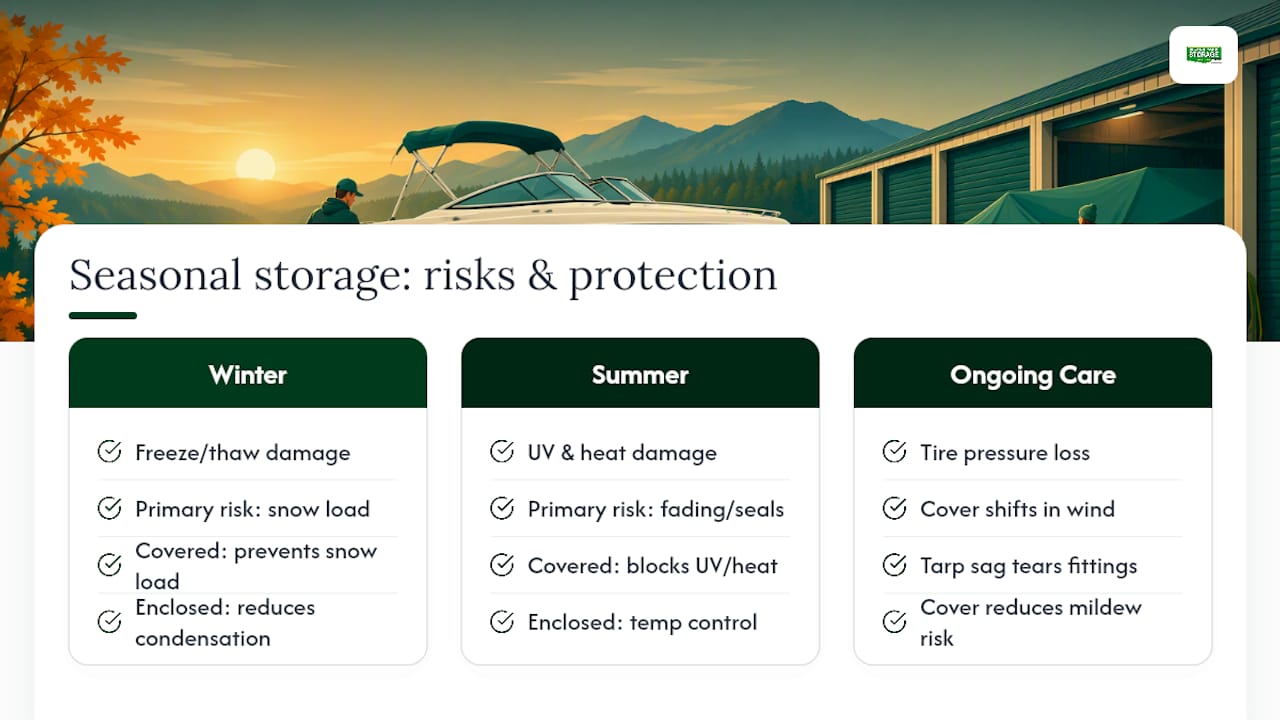
Winter is where storage decisions get tested. A boat trailer sitting through freeze/thaw cycles takes more abuse than one parked through a mild fall, and outdoor uncovered lots leave everything exposed to snow load, ice buildup on tires, and UV that doesn’t take a break just because it’s cold.
If you’re storing through winter in a region with real freezes, covered storage earns its higher price. It keeps snow off the hull and cover, which matters because a wet, heavy tarp sagging under snow can crack fittings or tear canvas. Enclosed storage goes further, keeping temperature swings smaller and cutting condensation that leads to mildew inside the cabin.
Summer storage brings a different problem: heat and UV. A boat sitting uncovered through July and August fades gelcoat and dries out rubber seals faster than winter cold ever will. A quality cover, even in an outdoor uncovered spot, does a lot of the same work a carport roof does, just with more setup effort each time you use the boat.
Whatever the season, check on your rig periodically rather than dropping it off and forgetting it for six months. Tires lose pressure slowly, covers shift in wind, and a five-minute check every few weeks catches small problems before they become expensive ones.
What Legal and Insurance Requirements Apply to Boat Trailer Storage?
Most cities don’t allow long-term boat trailer parking on public streets, and public boat ramp lots are built for loading and unloading, not storage. Leaving a trailer at a ramp lot overnight or longer often violates posted rules and risks a tow, according to a guide on boat ramp parking rules. If you’re tempted to use a ramp lot as free storage, check posted hours and consider a wheel or hitch lock at minimum, but understand it’s a short-term fix, not a real answer.
Private storage facilities typically require you to sign a month-to-month or term contract, and many either require proof of your own insurance on the boat and trailer or offer optional coverage add-ons. Ask directly whether the facility carries any liability for theft or weather damage, because most self-storage contracts limit facility liability and put the burden on the renter’s own policy.
Registration and trailer license requirements vary by state, but a stored trailer generally still needs current registration if it will ever leave the lot under its own plate. Keep registration paperwork current even during storage stretches so you’re not scrambling before your first spring launch.
Environmental Rules and Best Practices for Boat Trailer Storage
Fuel and fluid leaks are the most common environmental issue at storage facilities, and they’re entirely preventable with basic prep. Draining or stabilizing fuel before long-term storage cuts down on both leak risk and the gummed-up carburetor problems that come from stale gas sitting for months.
Dispose of old engine oil, lower-unit gear lube, and any other fluids at a certified recycling center rather than pouring them out or tossing them in regular trash. Most auto parts stores accept used oil for free, and it takes ten minutes out of your prep routine.
If your boat has a bilge, check it’s dry before storage and clean up any standing fuel or oil residue. A facility that finds a fuel sheen under your boat can charge cleanup fees or even terminate your contract, and it’s a hassle you can avoid with a five-minute check before drop-off.
How Accessible Is Your Stored Boat Trailer?
Access matters more than most people plan for until they’re standing at a locked gate on a Saturday morning with a full cooler and no way in.
Ask exactly how often you can get to your trailer and during what hours. Some facilities restrict access to daytime business hours only, which sounds fine until you want to leave before sunrise for a fishing trip. Others advertise open access but require staff to unlock a gate, which defeats the purpose if that staff isn’t around on weekends.
Location convenience is the other half of the equation. A storage spot that saves $30 a month but adds 40 minutes of driving each way costs you more in gas and time than it saves. Weigh the drive against how often you actually plan to use the boat, not how often you imagine using it.
Island Park Storage’s Take on Matching Storage to How You Actually Use Your Boat
Most boat owners underestimate how much they’ll want quick access until they’re stuck waiting on staff to open a gate. That’s why Island Park Storage leans toward drive-up vehicle parking with 24/7 access for most trailer owners. If you’ve got a high-value or rarely-used boat, though, we’d point you toward covered or enclosed options instead. Match the storage to how you use the boat, not just what it’s worth.
— Mike
Ready to Book? Measure Your Rig and Check Stall Sizes
Here’s the short version: measure your trailer’s LOA, pick a stall size that fits with room to spare, and skip the long-term contract if you’re not ready to commit.
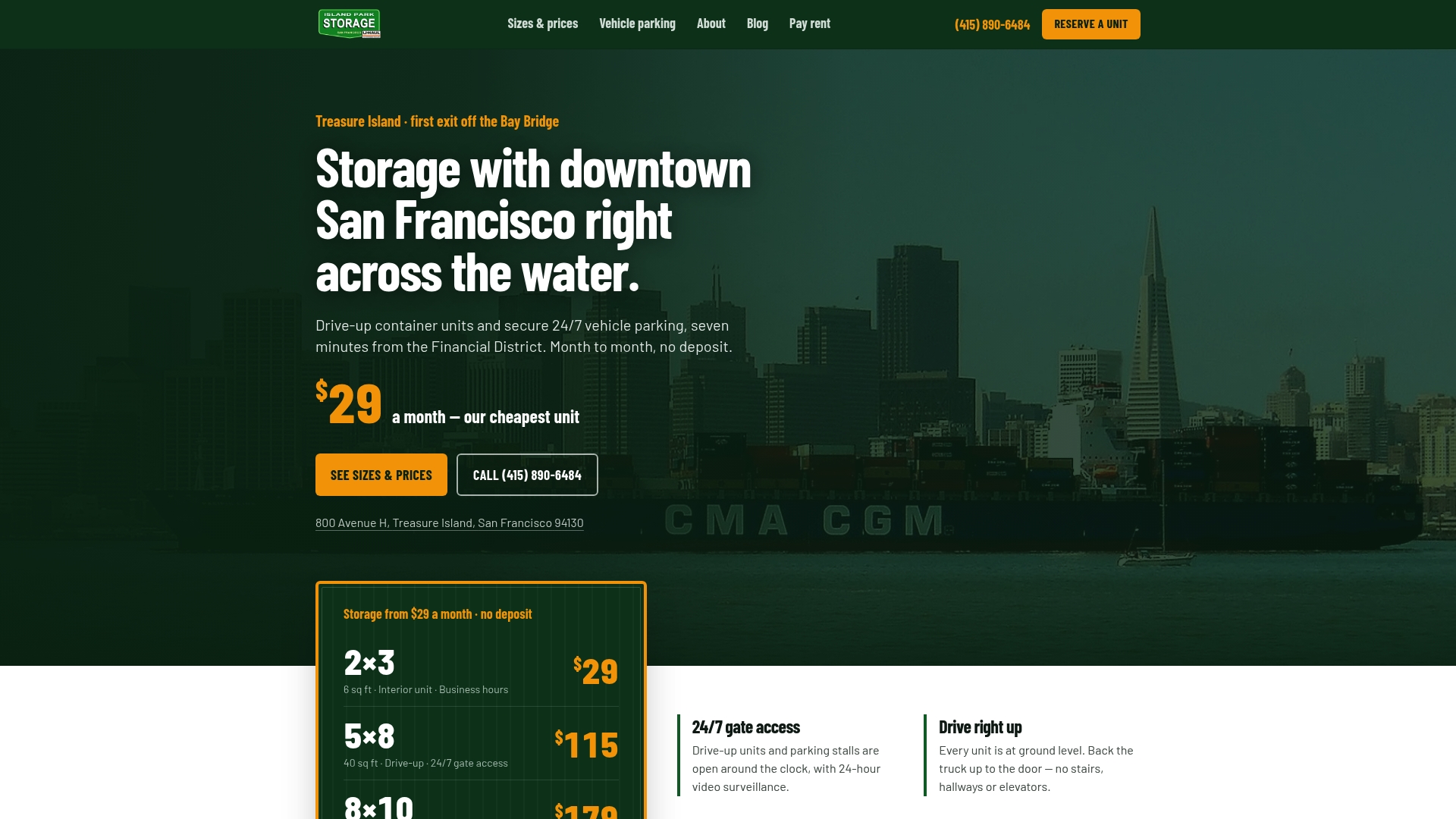
Some storage facilities offer month-to-month vehicle parking with no deposit required, avoiding the need to lock into a long contract before you know if the spot actually works for your schedule. Stalls may range in size and price, fitting various trailer types. Many include 24/7 gate access, which is important for early or late use. Location convenience varies.
Grab your tape measure, get your LOA number, then head to the vehicle parking page to compare stall sizes and check availability. If you’d rather talk it through first, on-site management is there to help you pick the right fit.
Sources
- 6 basic steps: winterizing your boat trailer & motor | BoatTest
- Boat trailer maintenance | Discover Boating
- Maintain trailer spindle sleeves | BoatUS
- Boat & RV storage cost guide (2026) | FindBoatStorage
FAQ
How Much Does It Cost to Store a Boat Trailer?
Monthly costs typically run $50 to $150 for outdoor uncovered spots, $100 to $250 for covered storage, and $200 to $500 for enclosed indoor units, according to FindBoatStorage’s cost data. Island Park Storage prices its vehicle parking stalls from $299 to $599 a month depending on size, with no deposit required.
How Much Does It Cost to Store a 20-Foot Trailer?
A 20-foot trailer usually falls into a mid-size stall category once you add the tongue and any outboard overhang, which often pushes total LOA several feet beyond the hull length. Expect to land in the $100 to $250 covered range or the equivalent linear-foot rate at most outdoor lots, though exact pricing depends on the facility’s size tiers.
What Are the Best Ways to Store a Boat Trailer Outside?
Outdoor uncovered parking is the most affordable option and works well for boats used often, since access is quick and unrestricted. Adding a quality boat cover and checking tire pressure periodically closes most of the gap between outdoor and covered protection without the higher monthly cost.
What Is the Most Affordable Way to Store a Trailer?
Outdoor uncovered storage is consistently the cheapest option, typically running $50 to $150 a month depending on region and facility. Prepaying for several months, asking about offseason discounts, and comparing at least three quotes usually finds the best rate in any given area.