

Most RV owners pay between $50 and $250 a month for storage, with the final number driven almost entirely by two factors: how much protection you buy and how long your rig is. Bare-bones outdoor parking sits at the bottom of that range. Enclosed or climate-controlled units push toward $500 or more. A safe starting budget is $50 to $150 a month for a mid-size trailer, plus a little cushion for fees you didn’t see coming.
TL;DR:
- RV storage costs vary mainly based on protection level, with outdoor parking costing $50 to $150 monthly and climate-controlled units reaching up to $600.
- Location significantly influences price, with high-cost states like California and Texas demanding higher rates than rural areas or less expensive regions.
- Additional fees such as move-in, insurance, electricity, and amenities can add $50 or more monthly, making precise quotes essential.
- Properly measuring your RV before obtaining quotes prevents size-related upcharges or misunderstandings at move-in.
- A typical seasonal storage for a 28-foot trailer in covered space can cost around $960 to $1,130 for six winter months, including fees.
Table of Contents
- How Much Is RV Storage by Type and Protection Level?
- Why Does RV Storage Cost More in Some States Than Others?
- What Extra Fees Should You Budget For?
- How Can You Lower Your RV Storage Bill?
- How Do You Measure Your RV for an Accurate Quote?
- Does Island Park Storage Fit These Cost Guidelines?
- What a Real Seasonal Budget Looks Like
- Ready to Lock in Your Rate? Check Availability Now
- Sources
- FAQ
How Much Is RV Storage by Type and Protection Level?
The cost of RV storage varies significantly based on the level of protection offered and is generally categorized into four types that increase in price and protection.
Outdoor or uncovered is the cheapest option, typically running $50 to $150 a month nationally. You’re parking on open gravel or asphalt with zero weather barrier. Fine for a rig you use often and don’t mind hosing off in spring.
Covered or canopy storage adds a roof over your RV without walls, usually $75 to $250 a month. This is the sweet spot for a lot of owners: it blocks the sun damage that wrecks seals and fades paint, without the enclosed-unit premium.
Enclosed or indoor storage puts your rig behind walls and a door, running $150 to $500 a month. Climate-controlled units, which regulate temperature and humidity, land at $200 to $600 a month and make sense mostly for high-value coaches or anyone storing somewhere with brutal winters.
| Storage type | Protection level | Typical monthly range | Rough midpoint |
|---|---|---|---|
| Outdoor/uncovered | Minimal | $50–$150 | $50 to $150 |
| Covered/canopy | Sun and light rain | $75–$250 | $160 |
| Enclosed/indoor | Full weather, some security | $150–$500 | $150 to $500 |
| Climate-controlled | Full weather plus temperature control | $200–$600 | $200 to $600 |
These national ranges hold up across most markets, though your state and your RV’s length will push you up or down inside each band.
Why Does RV Storage Cost More in Some States Than Others?
Location moves the needle almost as much as storage type does. The national median for RV storage sits between $65 and $150 a month, based on more than 1,600 verified facility prices. But that median hides a lot of spread.
States like Florida, Minnesota, Texas, California, and Washington tend to run on the higher end. States like New York, Idaho, Alabama, Michigan, and Louisiana often start lower. The pattern usually comes down to land value: a covered or enclosed bay eats up commercial-grade real estate, and that cost gets passed straight to you. A facility outside a dense metro almost always beats one wedged into a coastal city.
Size matters just as much as zip code. Facilities typically price by length, either per linear foot or in 5-foot bands. Here’s the math in practice:
- A 25-foot travel trailer might land in a 20 to 25-foot band, paying a baseline rate for outdoor parking.
- A 40-foot Class A in the 40+ band at the same facility could pay two to three times that baseline, even in identical outdoor conditions.
- Metro lots charge more per foot than rural ones, so a 30-foot rig stored just outside a city can beat the same rig stored downtown by a wide margin.
What Extra Fees Should You Budget For?
The quoted monthly rate is rarely the whole story. Facilities tack on charges that can add $50 or more a month if you don’t ask about them first.
- Move-in or admin fees, usually $20 to $75, charged once when you sign.
- Refundable deposits, which some facilities require and others skip entirely.
- Facility insurance, often $10 to $40 a month, sometimes optional and sometimes bundled into the rate.
- Electricity or metered hookups, typically another $10 to $40 a month if you want shore power running to your rig.
- Amenity fees for wash bays or dump stations, billed per use at some lots.
- Automatic rate increases built into long-term contracts, plus late fees if a payment slips.
Contract length changes your effective monthly cost too. Month-to-month gives you flexibility but sometimes carries a slightly higher rate than a locked-in annual term. Ask for an itemized quote before you sign anything, so the number you budget for is the number you actually pay.
How Can You Lower Your RV Storage Bill?
You don’t have to accept the first quote you get. A few smart moves can shave real money off your annual spend.
- Get quotes from at least three local facilities, and ask each one for an all-in written number, not just the advertised rate.
- Consider a site slightly farther from downtown. A 10-minute longer drive can mean a meaningfully lower monthly bill, especially in expensive metros.
- Skip amenities you won’t use. Climate control sounds nice, but if you’re storing a travel trailer for three months of winter, covered storage probably does the job for less.
- Prepay or bundle multiple vehicles. Longer commitments or storing a boat and an RV at the same facility commonly cut the effective monthly rate by 5 to 15 percent.
- Match the term to your usage. Seasonal storage for a rig you park all winter costs less overall than paying year-round for space you only need half the time.
How Do You Measure Your RV for an Accurate Quote?
Quoting your RV’s length wrong is the single easiest way to get upsold the day you show up to move in. Facilities price by length, and an inch missed on paper often means a whole size band bumped up at the gate.
- Measure bumper to bumper, including the hitch, any ladder, bike rack, or spare tire mount.
- Add exterior-mounted equipment like satellite dishes or awnings if they extend past the body.
- For enclosed or indoor units, check the facility’s stated door height and roof clearance against your RV’s actual height, including roof AC units or vents.
- Round up, not down, when you’re between two size bands.
Measuring correctly before you call around means the quote you get is the price you’ll actually pay.
Pro Tip: Snap photos at each measured point (hitch, roof AC, bumper) before you request a quote. If the facility’s number doesn’t match yours, you’ve got proof in hand instead of a debate at move-in.

Does Island Park Storage Fit These Cost Guidelines?
If you’re weighing these ranges against a real option, Island Park Storage offers vehicle parking in three sizes, 11×30, 11×40, and 11×66, all on month-to-month contracts with no deposit required. That flexibility matters if you’re not sure yet whether you need seasonal or year-round storage.
- The site is close to downtown San Francisco, in a location that may help avoid city traffic and high land-cost premiums.
- Drive-up self storage units, running from 5×5 up to 8×40, work if you’re storing gear, awnings, or supplies separately from the RV itself.
- On-site management means you can ask directly about access hours and any setup costs before committing, rather than guessing from a website.
When comparing this against any other quote, check access hours, gate security, and whether a move-in fee applies, the same questions that matter anywhere you park.
What a Real Seasonal Budget Looks Like
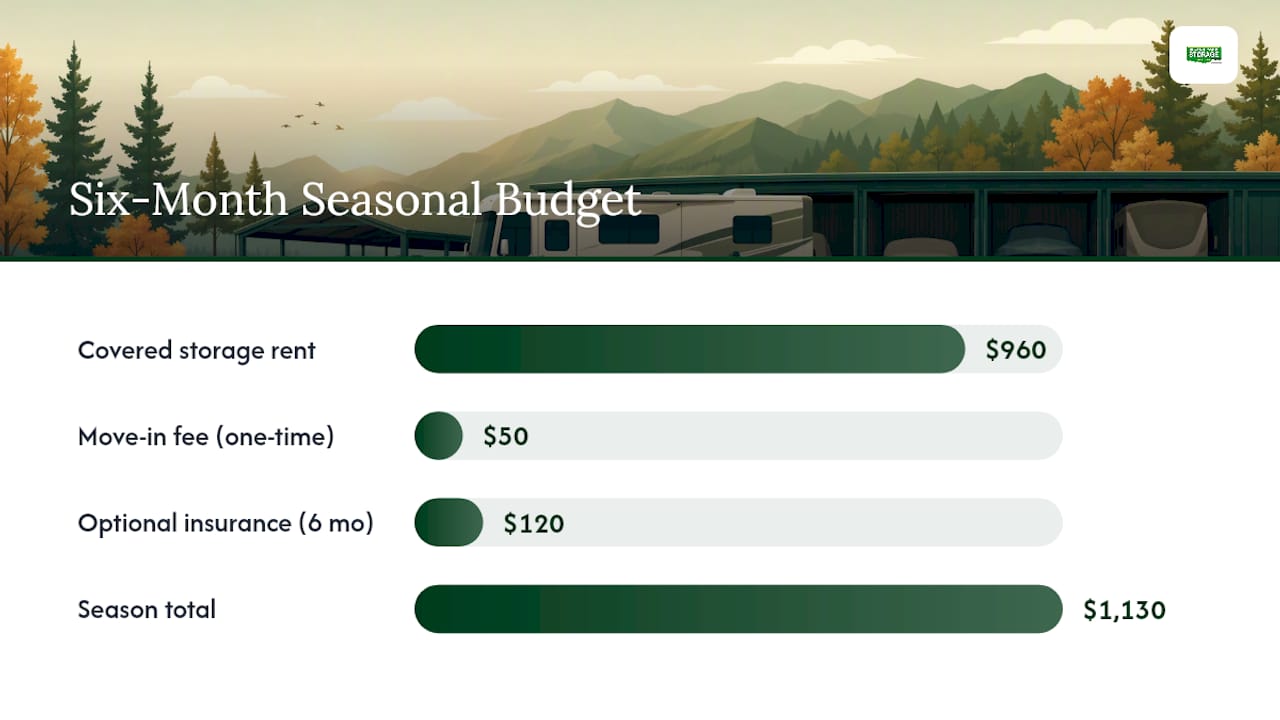
Run the math before you sign anything, not after. Say you’re storing a 28-foot travel trailer for six winter months in covered storage at $160 a month. That’s $960 in rent alone. Add a one-time move-in fee around $50 and optional insurance at $20 a month, and you’re closer to $1,130 for the season.
Paying more for enclosed or climate-controlled storage is worth it when your RV sits idle most of the year in a harsh climate, or when resale value justifies protecting the finish. For a rig you use most weekends, covered storage usually covers the real risks without the premium.
Before you sign anything: confirm the exact size band, get every fee in writing, and measure your rig yourself first.
— Mike
Ready to Lock in Your Rate? Check Availability Now
Island Park Storage skips the guesswork that comes with hunting through outdoor lots, covered canopies, and enclosed bays scattered across the city. It’s a month-to-month vehicle parking option minutes from downtown San Francisco, with no deposit required and on-site management who’ll actually answer your questions instead of routing you through a call center.

If you’ve read this far, you already know the smartest move is getting an itemized quote before you commit. Check current vehicle parking sizes and rates for your rig’s length, or browse drive-up unit options if you need separate space for gear and supplies. Ask about access hours, any move-in charges, and whether insurance is required. Then request your all-in monthly number and see how it stacks up against what you’ve budgeted here.
Sources
- RV Storage Cost by State: 2026 Rate Index | FindBoatStorage
- RV Storage Costs: Complete 2026 Pricing Guide | RV Storage Finder
FAQ
How Much Does It Cost to Store a 40-Foot RV?
A 40-foot Class A typically falls into the top size band at most facilities, often costing two to three times what a 25-foot trailer pays at the same lot in outdoor storage. For enclosed or climate-controlled space, expect to land near the top of the $150 to $600 national range, depending on your state and the facility’s specific size bands.
Why Is RV Storage So Expensive?
Cost comes down to land and protection. Enclosed and climate-controlled bays require valuable commercial real estate, and that expense gets passed to the renter. Add fees like insurance, electricity, and move-in charges, and the effective monthly cost climbs well past the advertised rate if you don’t ask for an all-in quote.
What Is the 4-4-4 Rule for RVs?
Definitions of this rule vary among RV owners and aren’t tied to storage pricing specifically. Most versions relate to driving limits (stopping by a certain time, driving a maximum number of hours) rather than storage costs, so treat any storage-specific claim about this rule with caution.
How Much Does It Cost to Store a 20-Foot Trailer?
A 20-foot trailer usually sits in the smallest size band, making it one of the cheaper rigs to store. Outdoor storage for this size often falls near the bottom of the $50 to $150 monthly range, though covered or enclosed options will cost more depending on your state and facility.
Does Island Park Storage Offer Month-to-Month RV Parking?
Yes. Island Park Storage offers vehicle parking in three sizes, 11×30, 11×40, and 11×66, all on flexible month-to-month contracts with no deposit required. Current rates are listed directly on the vehicle storage page.