
Month-to-month self-storage and vehicle parking work fine for artwork, as long as you pick the right unit type and treat security and climate like non-negotiables. Delicate paintings, works on paper, and anything long-term belong in a climate-controlled unit. Crated sculptures, framed pieces on their way somewhere, and vehicle-stored art (think RVs full of festival installations) can go in a drive-up container unit or parking stall. The one thing you can’t skip, no matter which option you pick, is a facility with real security and a stable environment.
TL;DR:
- Climate-controlled units are essential for sensitive materials like paintings and paper, especially if they are stored long-term, to prevent warping, cracking, and mold.
- Secure facilities should monitor temperature and humidity continuously, restrict access with controlled gates, and keep detailed handling and condition records for protection and insurance.
- Proper packing with archival barriers, shock-absorbing cushions, and rigid outer protection reduces damage risk during storage and retrieval.
- Regular condition checks every few months and designed storage arrangements help identify issues early and prevent long-term deterioration.
- For large, travel-ready art or vehicles, drive-up units and secure parking stalls are practical, but size measurement and proper environment remain critical.
Table of Contents
- Which Storage or Parking Type Actually Fits Your Art
- What to Check Before You Rent a Storage Unit for Art
- How to Pack Artwork for a Storage Unit or Parking Stall
- How to Retrieve Stored Art Without Damaging It
- What Art Storage Actually Costs
- Matching Storage Type to the Art You’re Storing
- Long-Term vs. Short-Term Art Storage: What Changes
- Pest Control and Protection for Stored Artwork
- Keeping Art in Good Condition While It’s in Storage
- How Island Park Storage Fits This Checklist
- Ready to Store Your Art the Right Way?
- How Island Park Storage’s Approach Compares
- Sources
- FAQ
Which Storage or Parking Type Actually Fits Your Art
Not every piece needs the same setup, and picking the wrong one either wastes money or risks damage. Here’s how to match the art to the space.
- Climate-controlled units hold steady temperature and humidity, which matters most for oil paintings, watercolors, unstretched canvas, and anything on paper. If your piece would warp, crack, or grow mold in a hot attic, it needs this option.
- Drive-up container units work for crated sculptures, framed prints in protective covers, or short-term overflow when you’re between studio moves. They’re not climate-controlled, so they suit tougher, well-packed pieces more than raw canvas.
- Vehicle, RV, or boat parking solves a problem a lot of artists don’t expect: what to do with large installations, kinetic sculpture, or a trailer full of gallery inventory. If it travels in a vehicle, it can often stay in that vehicle, parked securely.
Before you rent anything, measure your packed pieces (crate included) and calculate cubic feet, not just square footage. A five-foot canvas in a shallow crate needs less depth than people assume, but a stack of ten needs real vertical clearance. Undersizing a unit is the most common (and most avoidable) storage mistake artists make.
What to Check Before You Rent a Storage Unit for Art
A unit that looks fine on a tour can still be wrong for artwork. Here’s what actually matters, verified, not assumed.
Environmental controls. Ask if temperature and humidity are monitored and logged, not just “climate-controlled” on a sign. Museum-grade guidance targets roughly 68 to 72°F and about 50% relative humidity for many collections, and an alarmed HVAC system that flags failures beats one nobody checks until you show up.
Security. Gate access controls and consistent CCTV monitoring are the baseline for protecting anything valuable stored off-site. Look for restricted entry (not open lots), solid doors with real locks, and cameras that actually record, not just a mounted box.
Operational practices. The best facilities document intake condition, keep a digital inventory, and can tell you who touched your work and when. That chain-of-custody matters more than most renters realize until they need it for an insurance claim.
Other tenants matter too. A facility’s policies on what other renters can store nearby affect your art’s safety indirectly, so ask about restrictions on flammables, chemicals, or anything that could leak or attract pests.
Red flags: no written policy on temperature swings, staff who can’t describe their own security setup, units that smell of mildew, or a facility that can’t produce a condition report on request.
Pro Tip: Call ahead and ask specifically how humidity is monitored. If the answer is vague (“it’s climate-controlled, don’t worry”), that’s your answer about how seriously they take it.
How to Pack Artwork for a Storage Unit or Parking Stall
Packing wrong is how good pieces get damaged in perfectly good storage units. Follow this order every time:
- Add an archival barrier first. Use acid-free glassine, tissue, or paper directly against the surface. Never let plastic touch a painted or delicate surface directly, since trapped moisture causes more damage than dust ever would.
- Cushion next. Bubble wrap or foam goes around the barrier, not against the art itself, to absorb shocks during moves and transport.
- Finish with rigid protection. A crate, hard-shell case, or reinforced box goes on the outside. Paper works and canvases usually need less rigidity than sculpture, which often needs a full custom crate.
Not everything needs a crate. There’s a real middle ground between soft packing and full crating that saves money without risking the work. The right call depends on the medium, the storage term, and how often you’ll need access.
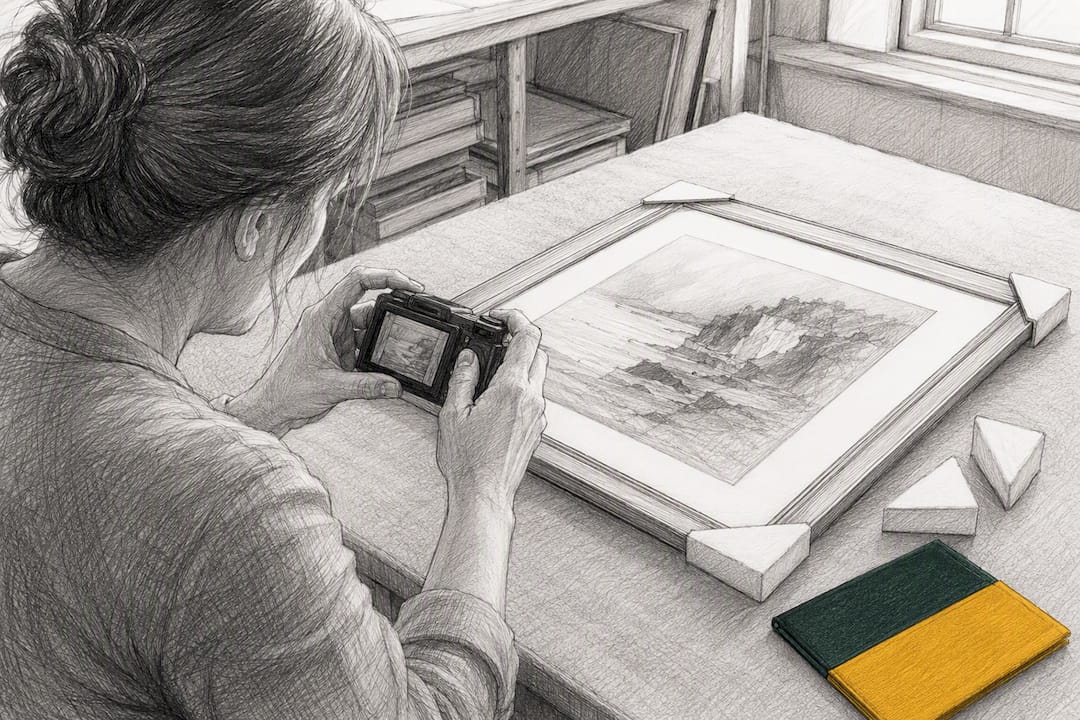
Before sealing anything, photograph the piece, note existing wear, and label the container with contents and orientation (“this side up” matters more than people think for stacked frames).
Repeated handling is where damage sneaks in. Every time a piece gets pulled, moved, and reshelved, there’s another chance for a corner to get bumped or a frame to get scratched, which is exactly why self-storage units without documented handling procedures carry higher damage risk during frequent retrievals.
How to Retrieve Stored Art Without Damaging It
The less you have to move other things to get to your piece, the safer it stays. Designing storage so each item is accessible on its own is a preservation strategy, not just a convenience.
- Use vertical racks for framed work and labeled crates for everything else, so you’re never digging.
- Get a condition report at intake and another at release. This pair of documents is your best friend if you ever need to file an insurance claim.
- For high-value or fragile pieces, schedule an escorted viewing rather than grabbing keys and going solo.
- Ask if the facility can provide a documented chain-of-custody and a recorded retrieval log. Good facilities keep this on file without you having to ask twice, and it materially reduces disputes when something looks off later.
What Art Storage Actually Costs
Standard self-storage runs cheaper than specialty fine-art facilities, and the gap is bigger than most people expect. Fine-art specialty sites add round-the-clock staffing, tighter climate standards, and specialized handling, which is exactly why their monthly rates run higher than a standard drive-up unit.
Watch for these extra charges before you sign anything:
- Dock or loading fees for large pieces
- Handling fees if staff move or retrieve items for you
- Viewing-room charges at specialty facilities
- Condition report fees (some include this, some charge per report)
On insurance: a facility policy rarely covers full replacement value. Standalone art insurance, priced to the actual value of your collection, closes that gap. Ask any provider directly: what’s covered, what’s excluded, and what documentation do you need on file to file a claim.
Matching Storage Type to the Art You’re Storing
Paintings, sculpture, and textiles don’t fail the same way, so they don’t store the same way either.
Paintings and works on paper are the most climate-sensitive category. Canvas expands and contracts with humidity swings, which is how you get cracking paint and warped stretcher bars. Paper is worse: it absorbs moisture, curls, and attracts mold in anything but a stable environment. Both belong in climate-controlled units, stored vertically on racks rather than flat and stacked.
Sculpture depends heavily on material. Bronze and stone tolerate temperature swings far better than plaster, resin, or mixed-media pieces with organic components. Weight is the other variable: heavy pieces need a unit with solid flooring and enough clearance to move them without dragging, and drive-up units often make more practical sense than climate-controlled interior units simply because you can get equipment to the door.
Textiles (tapestries, quilts, fiber art) need protection from both humidity and pests, and they need to be stored unfolded or rolled, never creased, to avoid permanent fold lines. Acid-free tubes for rolled textiles beat flat folding every time.
The common thread: match the unit to the material’s actual failure mode, not just its size. A rigid unit that protects a bronze sculpture perfectly could ruin a watercolor in a single humid summer.
Long-Term vs. Short-Term Art Storage: What Changes
The calculus shifts depending on how long a piece sits in storage, and treating a six-month stay like a five-year one (or vice versa) wastes money or risks damage.
Short-term storage (a few weeks to a few months) gives you more flexibility. A drive-up unit or vehicle stall is often fine even for moderately sensitive pieces, since the exposure window is short and month-to-month contracts let you move out the moment your show closes or your studio’s ready. Packing can lean toward the soft-pack middle ground rather than full custom crating, since the piece won’t sit untouched for years.
Long-term storage (six months or more) changes the math. Climate control stops being optional for anything sensitive, since even small humidity swings compound over time. Full crating earns its cost here, and periodic condition checks (every few months, not just at drop-off and pickup) catch problems before they become permanent. If you know a piece is going into storage for a year or longer, budget for a proper crate up front. It’s cheaper than restoration later.
The flexibility of a month-to-month lease matters most here: you’re never locked into a long-term storage commitment for a short-term need, and you’re never scrambling to renew when a long-term project runs longer than planned.
Pest Control and Protection for Stored Artwork
Pests do real damage to art, and it’s rarely obvious until you pull a piece out and find the problem already advanced. Textiles, paper, and wood-framed pieces are the most vulnerable, since insects like silverfish and carpet beetles feed directly on organic fibers and paper fibers.
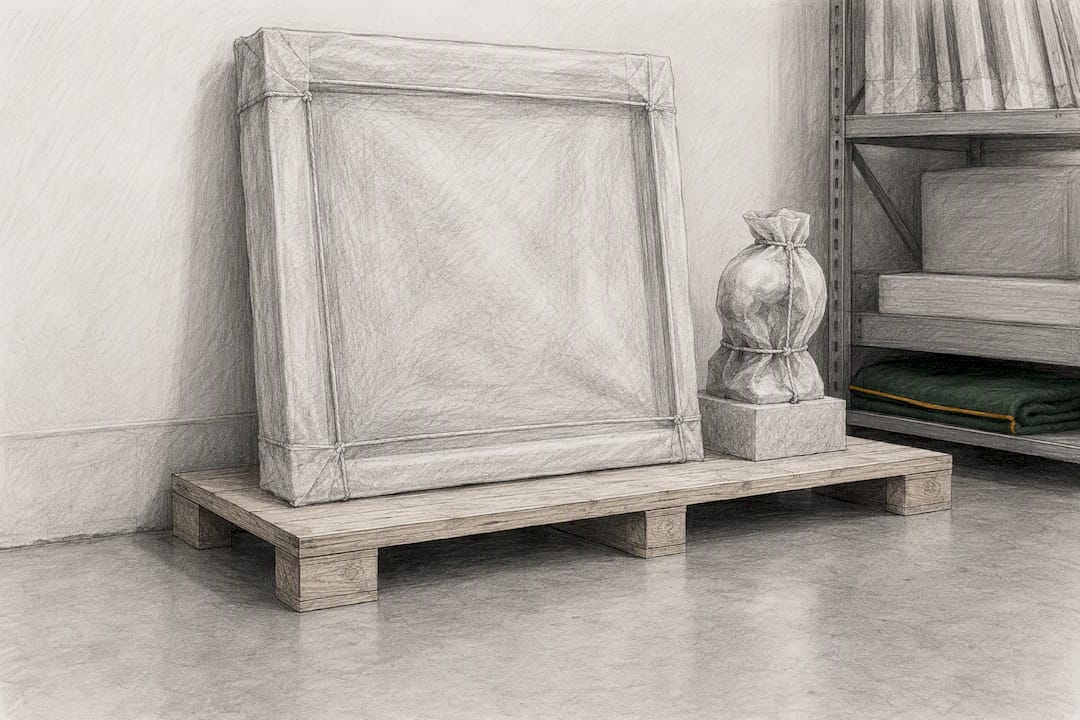
A few protective habits go a long way. Never store artwork directly on a concrete floor. Use pallets or shelving to create an air gap, since ground-level moisture attracts pests and encourages mold growth simultaneously. Avoid storing food, cardboard boxes with food residue, or organic packing materials near your art, since these attract exactly the pests you’re trying to avoid.
Ask your facility about their pest control program before you sign a lease. Regular treatment schedules, sealed unit construction, and clean common areas are all signs a facility takes this seriously. If a facility can’t answer basic questions about pest management, treat that as a red flag on par with poor security or unmonitored climate control.
For textiles specifically, cedar blocks or lavender sachets (never mothballs directly touching fabric) offer a mild additional layer of protection, though they’re a supplement to good facility hygiene, not a replacement for it.
Keeping Art in Good Condition While It’s in Storage
Two threats do quiet, long-term damage that most people never think about: light exposure and off-gassing materials.
Light exposure fades pigments and yellows paper, even in relatively brief exposure windows if the light is strong enough. Storage units generally solve this by default, since there are no windows, but be mindful of overhead lighting during retrievals and viewings. Don’t leave a piece sitting under bright lights for extended photography sessions or condition checks.
Off-gassing materials are the sneaky one. Certain plastics, adhesives, and even some woods release chemical compounds over time that can discolor or damage sensitive surfaces sitting nearby. This is exactly why acid-free materials matter directly against the artwork, and it’s also why you shouldn’t store art wrapped in ordinary plastic sheeting for extended periods. Use archival-rated materials at every contact point, not just the outer wrap.
Rotate condition checks on anything in long-term storage, even if you’re not planning to retrieve it soon. Catching a humidity problem or a pest issue in month three beats discovering it in month eighteen.
How Island Park Storage Fits This Checklist
Island Park Storage covers a lot of this checklist without you needing to piece it together yourself. Drive-up container units work well for crated sculpture and short-term studio overflow. Secure vehicle parking handles RVs, boats, or trailers carrying larger installations. Gate access means you can access your unit outside typical business hours, and month-to-month contracts mean you’re not locked into a long-term commitment. Management staff on site means you can ask questions in person.
This setup fits artists who need regular access, galleries managing rotating inventory, and anyone storing vehicle-based work.
Ready to Store Your Art the Right Way?
You’ve got the checklist now: stable environment, real security, and a facility that treats your work like it matters. The next move is simple.
 The facility offers drive-up container units and secure vehicle parking with 24/7 gate access and month-to-month contracts, providing flexible space that scales with your inventory.
Start by measuring your packed dimensions (crate included), then check unit sizes and pricing to find the right fit. If you’re storing an RV, boat, or larger vehicle-based work, look at vehicle and fleet parking options instead. Either way, on-site management is there to answer real questions, not read from a script. Reserve your space today and stop worrying about where your work lives between shows.
How Island Park Storage’s Approach Compares
Here’s what most art storage guides get backwards: they treat fine-art specialty warehouses as the only “real” option and self-storage as a compromise. That’s not quite right. A specialty facility earns its premium price with round-the-clock staffing and museum-grade everything, and if you’re storing a six-figure collection long-term, that premium is worth paying. But most artists, small galleries, and collectors reading this aren’t managing museum collections. They’re managing overflow, transition periods, and pieces that need to be accessible, not archived forever.
The real failure point isn’t the type of facility, it’s mismatched expectations. People assume any storage unit will “just work” for art, then discover too late that unmonitored humidity or careless handling did the damage a specialty vault would have prevented. The fix isn’t always spending specialty-facility money. It’s asking the right questions of whatever facility you choose: is the climate actually monitored, is access actually restricted, can they actually produce a condition report. A well-run drive-up facility that takes those questions seriously beats an expensive specialty warehouse that doesn’t.
— Mike
Sources
- Safely Storing Your Art: Expert Tips for Fine Art Storage — Museum Exchange
- How and Why Self-Storage Units Ruin Artwork: Top Threats — Fine Art Shippers
- Storage for Art: A Collector’s Definitive Guide — Colorado Art Services
- Art collectors’ guide to fine art storage — Observer
FAQ
Can You Store Paintings in a Regular Storage Unit?
Yes, but choose a climate-controlled unit specifically, since standard units without temperature and humidity control put paintings at risk of warping, cracking, or mold.
What Temperature and Humidity Are Best for Art Storage?
Most preservation guidance targets roughly 68 to 72°F and about 50% relative humidity for sensitive materials like paintings and paper.
Is Vehicle or RV Parking Suitable for Storing Art?
Vehicle and RV parking works well for crated sculptures and large installations that already travel inside a vehicle, and Island Park Storage offers secure parking stalls for this exact scenario.
How Often Should I Check Art in Long-Term Storage?
Check condition every few months rather than only at drop-off and pickup, since catching humidity or pest issues early prevents permanent damage.
Do I Need Special Insurance for Stored Artwork?
Facility-offered policies rarely cover full replacement value, so standalone art insurance priced to your collection’s actual worth is worth the extra cost for anything valuable.